Decolonizing Modern Freedom: A Reflection on the Barbarian
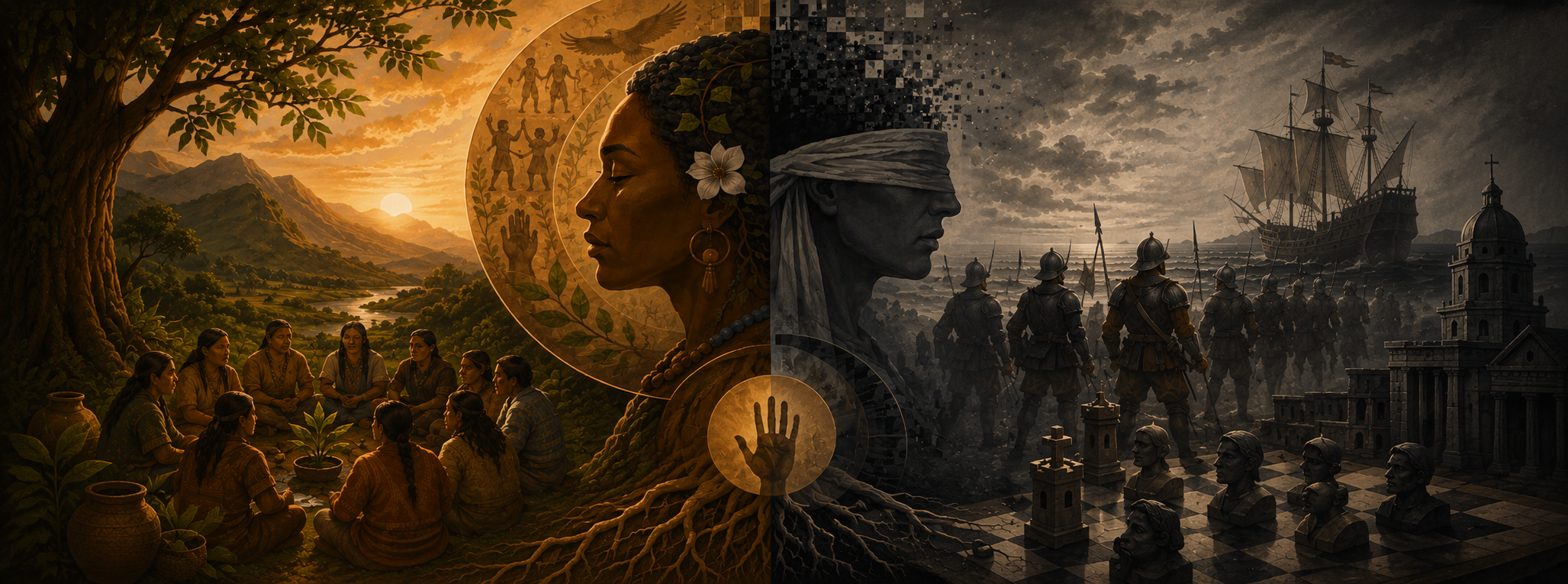
As I moved through the readings this semester, I kept encountering the same figure under different names: the barbarian, the savage, the natural slave, the one outside reason, outside history, outside freedom. At first, I approached these figures academically, as abstractions within philosophical systems. But over time, something shifted. The repetition began to feel personal. The barbarian stopped being a theoretical problem and started to feel like a projection—something Western modernity needed in order to understand itself as civilized, rational, and free.What unsettled me most was not simply the violence done to the barbarian, but the confidence with which that violence was justified. Again and again, European thinkers looked outward, encountered difference, and responded not with curiosity or humility, but with a compulsion to classify, rank, dominate, or correct. The more I read, the more I felt that colonialism was not soulless, as it is often described, but animated by a particular kind of soul—one marked by insecurity, scarcity, and an inability to coexist without control.I kept asking myself: what kind of inner life looks at a people minding their own business—living their culture, relating to the land, shaping meaning without the urge to conquer—and feels threatened by that? What kind of freedom requires constant infringement on others in order to feel real?I keep returning to this because so many of the texts insist—explicitly or implicitly—that domination is either natural, necessary, or even benevolent. The barbarian is rarely allowed to simply exist. They must be explained, managed, corrected, absorbed. Even when conquest is criticized, it is still framed as inevitable. Even when oppression is softened with moral language, it remains oppression. The barbarian becomes the proof of the civilized self, the boundary that makes “freedom” feel coherent for the people who claim it.And what trips me out is how uninterrogated this is within the tradition. There is so much confidence that freedom belongs to the people doing the naming, and so little doubt about the violence of naming itself. The “barbarian” is a label that does not describe—it positions. It places whole populations into an ontology of lesser-than. When I say it began to feel personal, I don’t mean I’m claiming a direct identity with every figure called barbarian across time. I mean I felt the emotional logic of the move: the way power makes itself feel justified by manufacturing someone else as inferior, immature, or dangerous.Aristotle’s idea of the “natural slave” felt like the philosophical seed of much that followed. His claim that some people lack the rational capacity for self-rule turns domination into destiny. Hierarchy becomes natural, inevitable, even benevolent. What struck me was not just the cruelty of the claim, but how easily it removes moral responsibility. If inequality is natural, then violence becomes maintenance rather than injustice. Reading Aristotle, I felt the beginning of a pattern: freedom is never assumed to belong to everyone. It must be earned, demonstrated, or conferred (Aristotle, Politics I.1–6, I.13).What stayed with me is how early this logic appears as a kind of calm certainty. It isn’t written like a scandal. It’s written like common sense. And that calmness is part of what makes it dangerous. It sets a precedent: certain people are, by nature, fit to rule; others are, by nature, fit to be ruled. From there, oppression becomes a form of “order.” The enslaver can even imagine himself as righteous, because he believes he is aligning society with nature.That pattern becomes explicit in the Valladolid debate. Sepúlveda argues that Indigenous peoples are barbaric and therefore deserving of conquest. Las Casas counters that they are rational and therefore deserving of protection. On the surface, this appears as a moral disagreement. But the deeper structure remains the same: humanity itself is placed on trial. Even in defense, Indigenous people must be measured against European standards of reason, governance, and religion. What disturbed me was the audacity of the entire exchange—the confidence that Europeans had the right to decide who counted as fully human. The world, over and over again, has been forced into the position of explaining why it deserves not to be destroyed (Las Casas, In Defense of the Indians, Preface; chs. 1–7, 34–38).The part I couldn’t shake wasn’t only Sepúlveda’s argument—it was the courtroom itself. The whole scene is structured as if Europe has been appointed the moral center of the world. Las Casas is often remembered as a defender, but what I felt in his defense was something that still carries the imprint of hierarchy: he argues for Indigenous humanity using criteria that are not Indigenous. Even the sympathetic position is still a position of power. It’s as if the only way to be protected is to be recognizable to the colonizer’s framework.This is where colonialism’s spiritual ugliness becomes clearest to me: it doesn’t only want to dominate; it wants to feel noble while doing it. It wants to tell itself it is saving you while it takes your life apart. It makes morality into a performance that covers over the deeper problem: the presumed right to decide who is human enough.Francisco de Vitoria refines this logic by introducing a universal law of nations that claims neutrality while authorizing intervention. Indigenous peoples technically possess rights, but only so long as those rights are exercised “properly.” Freedom is acknowledged in theory and revoked in practice. This is colonialism learning to speak the language of morality. It is domination with clean hands. Reading Vitoria, I felt how dangerous universality can be when it is defined by only one tradition and enforced by power (Vitoria 232–292).Vitoria’s “neutral” tone almost makes the violence harder to see, and that might be the point. There’s something chilling about oppression that has learned to justify itself through law. Conquest becomes procedure. Control becomes “order.” And the idea of universality becomes a trap—because whoever defines the universal also defines who is deviant from it. At that point, the barbarian is not simply different; the barbarian is “noncompliant.”Hobbes deepened my discomfort. His depiction of the state of nature as violent chaos felt less like an observation of humanity and more like a projection of his own society’s bloodthirstiness. Fear becomes the foundation of political order. Freedom is no longer expansive or relational; it is defensive. What troubled me most was how Hobbes universalizes paranoia and then uses it to justify sovereign domination (Hobbes, Leviathan chs. 13–15; ch. 17).I kept thinking: what if Hobbes is describing not humanity, but an imperial worldview—one that assumes betrayal because betrayal is what it practices? His account makes suspicion seem like maturity and trust seem like childishness. And then, once suspicion is normalized, domination can be framed as protection. The sovereign becomes necessary not because people are inherently violent, but because the theory insists they are. It becomes self-fulfilling: if you believe the world is a war, you will build a world that feels like war.This connects directly to something I can’t stop thinking about: non-white peoples weren’t necessarily “unprepared” because they were inferior. They were unprepared because they did not imagine that another group would cross oceans to decimate them. That kind of imagination—an imagination that can envision annihilation as an option—says something about the people who have it. Hobbes takes that imagination and universalizes it. And that feels like gaslighting: turning your own violence into “human nature” and then blaming others for not anticipating it.Montesquieu’s geographic determinism felt like another turn of the same screw. Cultural difference is explained through climate, turning hierarchy into science. I was struck by how little curiosity there was in this move. Surface observation replaces relationship. People are summarized rather than understood. What feels especially insidious is how this logic masquerades as objectivity while preserving the same racial conclusions. Theology gives way to pseudo-science, but the outcome remains unchanged (Montesquieu, Spirit of Laws bks. XIV–XVIII).This is one of the most exhausting parts of colonial thought to me: the way it refuses intimacy, refuses knowing, refuses humility—and then declares itself knowledgeable. It’s a shortcut that harms people. It turns entire histories into stereotypes and then calls those stereotypes “research.” And I see echoes of this today any time someone tries to reduce cultures to “temperament,” “work ethic,” “family values,” or whatever coded language people use now. Montesquieu makes it feel respectable.Rousseau initially seemed different. His critique of civilization and his admiration for the “noble savage” felt like a break from outright condemnation. But the relief was short-lived. The savage in Rousseau’s work is frozen in time—pure, innocent, and premodern. Admired, but not taken seriously as a contemporary or future-oriented subject. I found this especially painful. Even when loved, the barbarian is denied futurity. They are permitted to exist only as a mirror for Europe’s self-critique, not as agents of history (Rousseau 87–138).This is where I learned that romanticization can be its own kind of violence. If you preserve someone as pure, you also preserve them as static. You make them a symbol instead of a person. You deny them complexity. In a strange way, the “noble savage” still serves the same function as the savage-as-threat: both are there to manage Europe’s self-image. One is the enemy that justifies conquest; the other is the fantasy that allows Europe to mourn itself.Kant’s conception of freedom as autonomy through reason sharpened this exclusion. On the surface, his moral philosophy insists on universality. In practice, his racial writings quietly delimit who counts as rational. Reason becomes a gatekeeper. Freedom is available in principle, but inaccessible to those deemed incapable of meeting its standards. Reading Kant, I felt the betrayal of Enlightenment thought—the realization that universalism can coexist comfortably with hierarchy when definitions remain unexamined (Kant, Groundwork 7–18; Kant, “Different Races”; Kant, “Enlightenment”).Kant’s work forced me to confront something I already sensed: freedom is often presented as a gift of reason, but reason is not neutrally defined. The “rational subject” is not simply anyone; it’s a particular model of personhood. Once reason becomes the entry ticket, whole populations can be positioned as not yet fully free—not because they lack dignity, but because the system has defined dignity in its own image. It’s painful to realize how much “universal” philosophy depends on an unspoken template of the human.Hegel closes the door even further by tying freedom to history and the state. To be free is to be recognized within a political order that embodies rational progress. Entire continents are written out of history, positioned as pre-historical or stagnant. What haunted me here was the foreclosure of possibility. To exist outside history is to be denied not only a past, but a future. The barbarian is not just unfree; they are unreal (Hegel, Philosophy of Right §§5–7, 93, 243–248, 349–351).This is where I began thinking about time as a form of domination. If Europe gets to define what counts as progress, then Europe also gets to define who is behind. The barbarian becomes “not yet,” forever. And if you’re always “not yet,” then your present is treated as irrelevant. You can be studied, managed, converted, exploited—but not recognized as fully inhabiting time.Hannah Arendt helped me articulate something I had been circling all semester: the fragility of rights. Her observation that rights only exist where one belongs politically exposes the limits of modern freedom. Stateless people reveal the lie beneath universal human rights. Without recognition, freedom evaporates. I found this devastating, not only historically, but in its implications for the present. Reality itself becomes conditional (Arendt 290–302).Arendt’s writing made me think about how modernity claims to love humanity but organizes reality through membership. You can be human, but not belong. You can be alive, but not count. The “right to have rights” becomes dependent on political recognition, and once you see that, you start seeing how much of modern freedom is administrative. It is not only moral; it is bureaucratic. It is not only about ideals; it is about papers, borders, systems that decide who is visible.Talal Asad gave me language for why so many ways of being are perpetually treated as suspect. Secular freedom is not neutral; it disciplines. Certain practices are labeled irrational, excessive, or backward not because they cause harm, but because they resist translation into dominant frameworks. The barbarian, in this sense, is one who refuses to explain themselves endlessly (Asad, ch. II).Asad helped me see that “freedom” can be a form of regulation. Modernity tolerates difference, but only up to the point where difference challenges its self-definition. Some ways of being have to translate themselves constantly to be acceptable. Others are accused of being irrational simply because they are not legible to the dominant culture. The demand for legibility becomes another demand for submission.Charles Mills finally names what so many others obscure. The racial contract makes explicit that exclusion is not an accident of modern freedom—it is its foundation. Reading Mills felt like an exhale. The pattern I had been sensing was real. White supremacy is not a deviation from liberalism; it is one of its operating conditions (Mills, Introduction; ch. 1).Mills did something that felt almost like emotional relief: he said the quiet part out loud. So many earlier texts either ignore race or treat it as incidental, but Mills forces the recognition that the modern world was built through racial domination and that political theory often functions as a cover story for that reality. After Mills, it becomes harder to pretend that the barbarian is simply misunderstood. The barbarian is produced as a category, maintained as a boundary, used as a justification.What remains with me after this course is grief. Grief for the worlds that could have been if non-extractive, non-dominating ways of life had been allowed to flourish. Grief for forms of freedom rooted in relationality rather than control. And anger at the irony that the humanity of the barbarian is declared irrelevant while their land, labor, creativity, and resources are relentlessly desired. Humanity is denied, usefulness preserved.This is the contradiction that keeps ringing in my ears: the barbarian is treated as inferior, but never treated as unimportant. Their space is coveted. Their labor is demanded. Their culture is mined. Their genius is appropriated. Their bodies are exploited. Their spirituality is extracted and repackaged. Colonialism does not reject the barbarian; it rejects the barbarian’s autonomy. It rejects the idea that the barbarian can exist without being owned, interpreted, or controlled.And this brings me back to the question I started with: what kind of soul is this? The one that cannot share? The one that cannot be happy alongside another people’s happiness? The one that feels compelled to dominate because equality would force self-confrontation?If colonialism has a soul, it feels to me like a soul addicted to supremacy and terrified of inadequacy. It feels like a soul that uses “freedom” as a slogan but does not know how to practice freedom—even for itself. Because a people who truly value freedom would recognize that other peoples’ freedom is not a threat. They would know how to leave others alone.Engaging these texts from within the system often feels futile, because the system was never designed to care about such critiques. And yet, I find myself committed to standing outside of it—to imagining and encouraging the building of alternative systems that do not require domination in order to function. Perhaps the most radical response to colonial modernity is not reform, but refusal: the quiet, persistent work of building worlds alongside it until one day it becomes an afterthought rather than a horizon.To decolonize freedom, I have come to believe, is not simply to expand inclusion within existing frameworks. It is to question the fear, insecurity, and violence that made exclusion feel necessary in the first place—and to dare to imagine futures that do not require barbarians in order to feel civilized.I don’t mean futurism as an aesthetic alone. I mean futurism as a spiritual and political stance: the refusal to accept that modernity is the final form of reality. The refusal to accept that the European state is the only vessel for legitimacy. The refusal to accept that freedom must look like autonomy severed from community, or rights severed from belonging, or progress severed from care. I mean futurism as a return to possibility—possibility that was foreclosed not because it lacked value, but because it threatened an empire’s self-image.If this course gave me anything, it is a clearer sense that the barbarian is not the absence of freedom. The barbarian is a mirror that exposes modernity’s insecurity. The barbarian reveals the fear underneath the civilized mask. And if I’m honest, that recognition does not only make me angry. It makes me mourn. Because it suggests that so many beautiful human possibilities—open-heartedness, non-extractive coexistence, plural worlds—were treated as weaknesses rather than gifts.But I don’t want to end in despair. If the “barbarian” was used to justify domination, then reclaiming what was demonized can also be a form of liberation—not by romanticizing the past, but by insisting that other ways of being are still possible. To decolonize modern freedom is, for me, to stop asking for permission to be human—and to stop accepting a world where anyone has to.Works Cited
Arendt, Hannah. The Origins of Totalitarianism. “The Perplexities of the Rights of Man,” pp. 290–302.Aristotle. Politics. Book I, §§1–6, §13.Asad, Talal. Formations of the Secular. Chapter II.Hegel, G. W. F. Elements of the Philosophy of Right. §§5–7, 93, 243–248, 349–351.Hobbes, Thomas. Leviathan. Part I, chs. 13–15; Part II, ch. 17.Kant, Immanuel. Groundwork of the Metaphysics of Morals. Section I, pp. 7–18.Kant, Immanuel. “On the Different Races of Man.”Kant, Immanuel. “What Is Enlightenment?”Las Casas, Bartolomé de. In Defense of the Indians. Preface; chs. 1–7, 34–38.Mills, Charles W. The Racial Contract. Introduction; Chapter 1.Montesquieu. The Spirit of Laws. Books XIV–XVIII.Rousseau, Jean-Jacques. Discourse on the Origin and Foundations of Inequality Among Men (Second Discourse). pp. 87–138.Vitoria, Francisco de. On the American Indians. pp. 232–292.The author acknowledges the use of OpenAI's ChatGPT (Version GPT-4o) to improve the readability and structural flow of the Introduction and Discussion sections. The tool was utilized strictly for paragraph tightening and grammatical refinement. All conceptual frameworks, data interpretations, and final editorial decisions were made and verified entirely by the human author, who accepts full responsibility for the content.