Slow Culture vs Fast Capital: Black Land, Futurism, and the Sea Islands
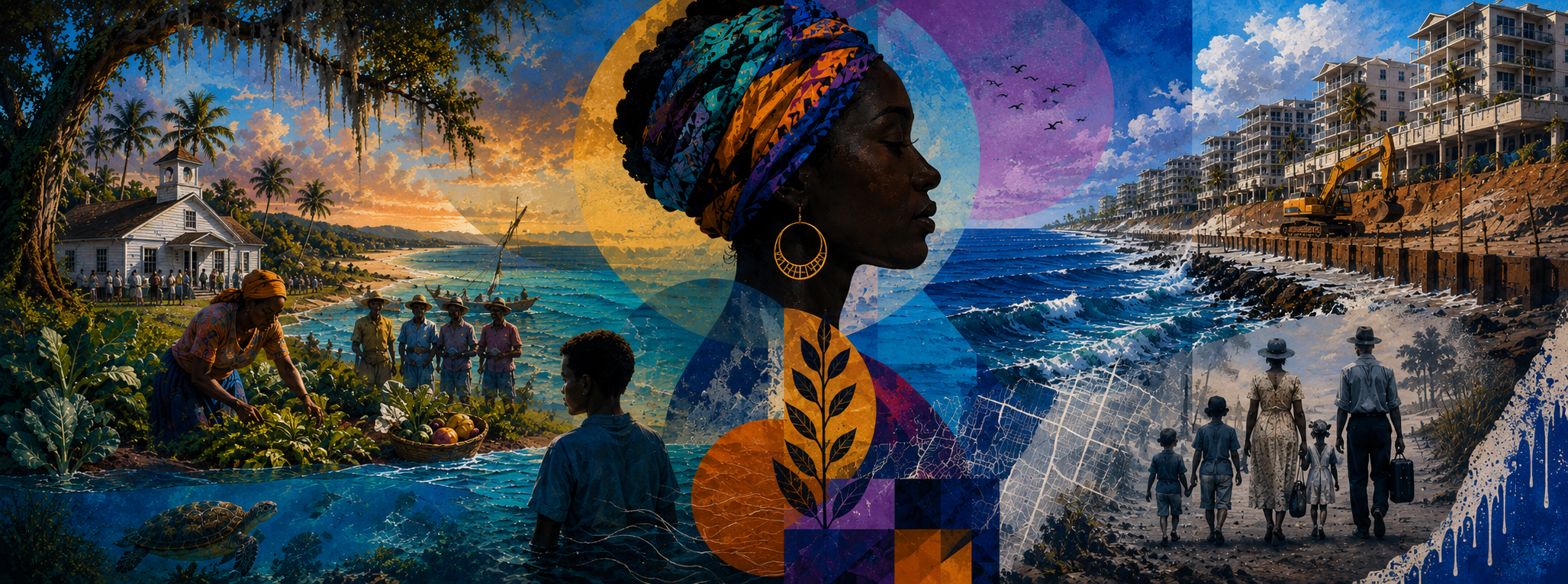
The history of Black land ownership in the Sea Islands of northeast Florida offers a powerful lens through which I came to understand the relationship between land, autonomy, cultural continuity, and futurism. My own family’s story forms part of that history. My relatives trace their roots to Franklintown, a freedmen’s community established on Amelia Island around 1867 by formerly enslaved people who remained in the Sea Islands and built independent settlements during Reconstruction (Florida Public Archaeology Network 2017). Later generations of my family moved a short distance from Franklintown to American Beach, a historically Black coastal community founded in 1935 during segregation by entrepreneur A. L. Lewis, president of the Afro-American Life Insurance Company (Phelts 2012).
Using my family’s story as a microhistory, this essay examines a broader pattern in the history of Black land in the Sea Islands. As I began studying this history, one point became increasingly clear to me: cultural continuity alone does not protect land. Black land communities across the United States have repeatedly lost land despite strong traditions of inheritance and cultural attachment to place. The central problem, as I see it, is therefore not simply external development pressure but whether the culture surrounding these communities has developed the institutions and strategic coordination necessary to defend the land it claims to value.
Amelia Island sits within the broader Sea Islands region, a chain of barrier islands stretching along the Atlantic coast from North Carolina to Florida. These islands form part of the Gullah Geechee cultural corridor, where African-descended communities developed distinctive traditions shaped by slavery, coastal agriculture, and geographic isolation (National Park Service 2018). Scholars of Black foodways note that land stewardship and food production became essential to survival in these communities following emancipation (Carney 2001; Reese 2019). Land therefore functioned not simply as property but as a foundation for autonomy and cultural continuity.
Plantations on Amelia Island, including the Harrison Plantation in the Nassauville area near the Amelia River, relied on enslaved African labor to cultivate crops and maintain subsistence food systems typical of the Sea Islands plantation economy (Amelia Island Museum of History 2015). Historians have shown that enslaved Africans brought extensive agricultural knowledge that shaped farming practices across the coastal South (Carney 2001). After emancipation, that knowledge became the foundation upon which newly freed communities attempted to build independent settlements.
One individual who represents this transition in my own family history is my great-great-great grandfather, Gabriel Means. Means had been enslaved on the Harrison Plantation before serving with Union forces during the Civil War. The collapse of plantation authority across the Sea Islands during the war created conditions for formerly enslaved people to reorganize agricultural life for themselves. The most famous example of this transformation was the Port Royal Experiment in South Carolina, where formerly enslaved people began cultivating abandoned plantations and experimenting with forms of Black agricultural independence and self-governance (Berlin et al. 1998; Rose 1964).
After the war, formerly enslaved residents from plantations across Amelia Island—including those who had lived on the Harrison Plantation—established independent communities nearby. My ancestor Gabriel Means returned to the island after the war and became part of the generation of freedmen who helped cultivate and sustain Franklintown during Reconstruction. To me, this moment represents an earlier form of cultural adaptation: freedpeople did not simply preserve plantation-era knowledge, they reorganized it to build entirely new communities. The movement from plantation labor to freedmen’s settlements across the Sea Islands demonstrated that Black communities were capable of transforming inherited systems when survival required it.
Franklintown became one such community. Residents farmed land, fished nearby waters, and established churches and schools that anchored social life (Florida Public Archaeology Network 2017). These diversified systems allowed families to support themselves outside the plantation economy that had previously structured their lives. As scholar Monica White argues, Black farming has historically functioned not only as an economic activity but also as a form of resistance and self-determination (White 2018).
Elements of this land relationship continued within my own family’s life on American Beach. At my grandparents’ home, my grandmother maintained a backyard garden and the yard contained fruit trees that we regularly picked from as children. Looking back, these practices reflect a much older pattern of Black land stewardship in the Sea Islands, where small-scale cultivation functioned as both a food system and a cultural inheritance (Reese 2019).
Yet the autonomy represented by communities such as Franklintown proved vulnerable to outside forces. By the early twentieth century, coastal development and land speculation began reshaping Amelia Island. Historical documentation indicates that Franklintown residents were gradually displaced as land was acquired for resort development and commercial expansion (Amelia Island Museum of History 2015). Today Franklintown survives largely as an archaeological site and historical memory rather than a living community.
American Beach, founded in 1935 as a coastal refuge for African Americans during segregation, represents a later attempt to create Black autonomy along the shoreline (Phelts 2012). While the community still exists as a residential enclave, it now faces persistent development pressure. Because the land sits along a highly desirable stretch of coastline, developers have repeatedly shown interest in acquiring property for large-scale coastal projects (Florida Times-Union 2021; News4Jax 2022).
What becomes clear when examining these patterns is that developers often do not need to forcibly remove communities. They can simply wait for internal fragmentation to do the work for them. Land in communities such as American Beach is frequently inherited through heirs’ property structures in which multiple descendants share ownership. As families grow and disperse geographically, dozens of individuals may hold partial interests in the same land. Scholars studying heirs’ property have shown that these ownership structures weaken families’ ability to coordinate decisions about land use and preservation (Mitchell 2001).
In many cases land loss occurs not through dramatic confrontation but through slow erosion of unity within the community itself. If historically Black land communities are serious about preservation, unity cannot remain a symbolic ideal. It must function as an operational strategy capable of coordinating collective decisions about land.
These dynamics reveal what I see as a deeper tension between cultural continuity and economic acceleration. Historically Black communities often emphasize preservation, inheritance, and respect for ancestral land. Yet the economic systems reshaping coastal land operate through speed, coordination, and capital. Real estate development and speculative investment move quickly and strategically. Cultural continuity alone cannot compete with systems organized around economic acceleration.
What becomes necessary in this situation is what I would describe as “updating culture”. Updating culture means preserving core values—ancestral responsibility, land stewardship, and continuity—while redesigning the institutional structures that defend those values. If development operates through legal coordination, capital mobilization, and political influence, communities attempting to preserve land must develop strategies capable of operating within those same systems.
Other communities confronting land loss have already adopted such strategies. In New Zealand, for example, Māori land governance systems place certain ancestral lands under collective ownership structures that make it extremely difficult to sell culturally significant land outside the community. Much of this land is legally classified as Māori freehold land and governed through the Māori Land Court, which prioritizes long-term cultural stewardship over individual land sales (Boast 2008). These systems demonstrate that protecting culturally significant land often requires formal institutions designed specifically to resist speculative markets.
Historically Black land communities in the United States have rarely received comparable structural protections. Instead, families confronting land loss have often been left to rely on informal networks rather than coordinated legal infrastructure.
If historically Black land communities intend to preserve their land, several strategies already exist. Community land trusts can remove land from speculative markets and place it under collective stewardship. Cooperative ownership structures can prevent individual heirs from selling land without broader community approval. Legal reforms addressing heirs’ property can strengthen families’ ability to coordinate land decisions (Nembhard 2014; Mitchell 2001). Communities can also leverage digital media to document land histories, mobilize dispersed descendants, and attract national attention when development threats arise.
For me, the lesson of this history is clear: the survival of historically Black land communities will not be determined by nostalgia alone. Cultural continuity created these landscapes, but continuity by itself cannot defend them against the economic forces reshaping coastal land today. If communities such as American Beach intend to remain more than historical memory, they must develop the institutions, leadership, and strategic coordination necessary to protect the land in real time. The question facing the next generation is therefore not whether these communities value their history, but whether they are willing to organize themselves in ways capable of defending it.
The author acknowledges the use of OpenAI's ChatGPT (Version GPT-4o) to improve the readability and structural flow of the Introduction and Discussion sections. The tool was utilized strictly for paragraph tightening and grammatical refinement. All conceptual frameworks, data interpretations, and final editorial decisions were made and verified entirely by the human author, who accepts full responsibility for the content.
Works Cited
Berlin, Ira, et al. Free at Last: A Documentary History of Slavery, Freedom, and the Civil War. The New Press, 1998.
Boast, Richard. Maori Land Law. 2nd ed., LexisNexis, 2008.
Carney, Judith A. Black Rice: The African Origins of Rice Cultivation in the Americas. Harvard University Press, 2001.
Florida Public Archaeology Network. “Franklintown Archaeology Project.” University of West Florida, 2017.
Mitchell, Thomas W. “From Reconstruction to Deconstruction.” Northwestern University Law Review, vol. 95, no. 2, 2001.
Nembhard, Jessica Gordon. Collective Courage. Pennsylvania State University Press, 2014.
National Park Service. Gullah Geechee Cultural Heritage Corridor Management Plan. 2018.
Phelts, Marsha Dean. An American Beach for African Americans. University Press of Florida, 2012.
Reese, Michael W. Twitty. The Cooking Gene. Amistad/HarperCollins, 2019.
White, Monica M. Freedom Farmers. UNC Press, 2018.
Amelia Island Museum of History. African American History of Nassau County and Amelia Island. 2015.
Florida Times-Union. “Residents of Historic American Beach Push Back Against Development Pressure.” 2021.
News4Jax. “Historic American Beach Residents Raise Concerns Over Coastal Development.” 2022.