The Black L.A. Web Series Renaissance & the Pioneering Black New Media Revolution of the Early 2010s
How a Generation of Black Creators Built Its Own Television Industry, Then Watched the Future Forget It
The Dream Was Already on the Screen
There is a strange contradiction at the center of the Black Web Series Movement. Many of the people who built it grew up during what may have been the richest period of Black screen culture in modern American history. They watched Black sitcoms after school. They watched Black television movies on weeknights. They watched Black filmmakers dominate cultural conversations. They watched Black actors become stars. They watched Black stories move fluidly between television, music videos, independent cinema, studio films, and popular culture. The screen suggested abundance. The screen suggested possibility. The screen suggested there would be room. Then they grew up, and much of that world was gone. Enough that a generation of aspiring Black filmmakers, writers, actors, and producers increasingly found themselves asking a question that would eventually reshape independent media: What happens when the doors begin to disappear?
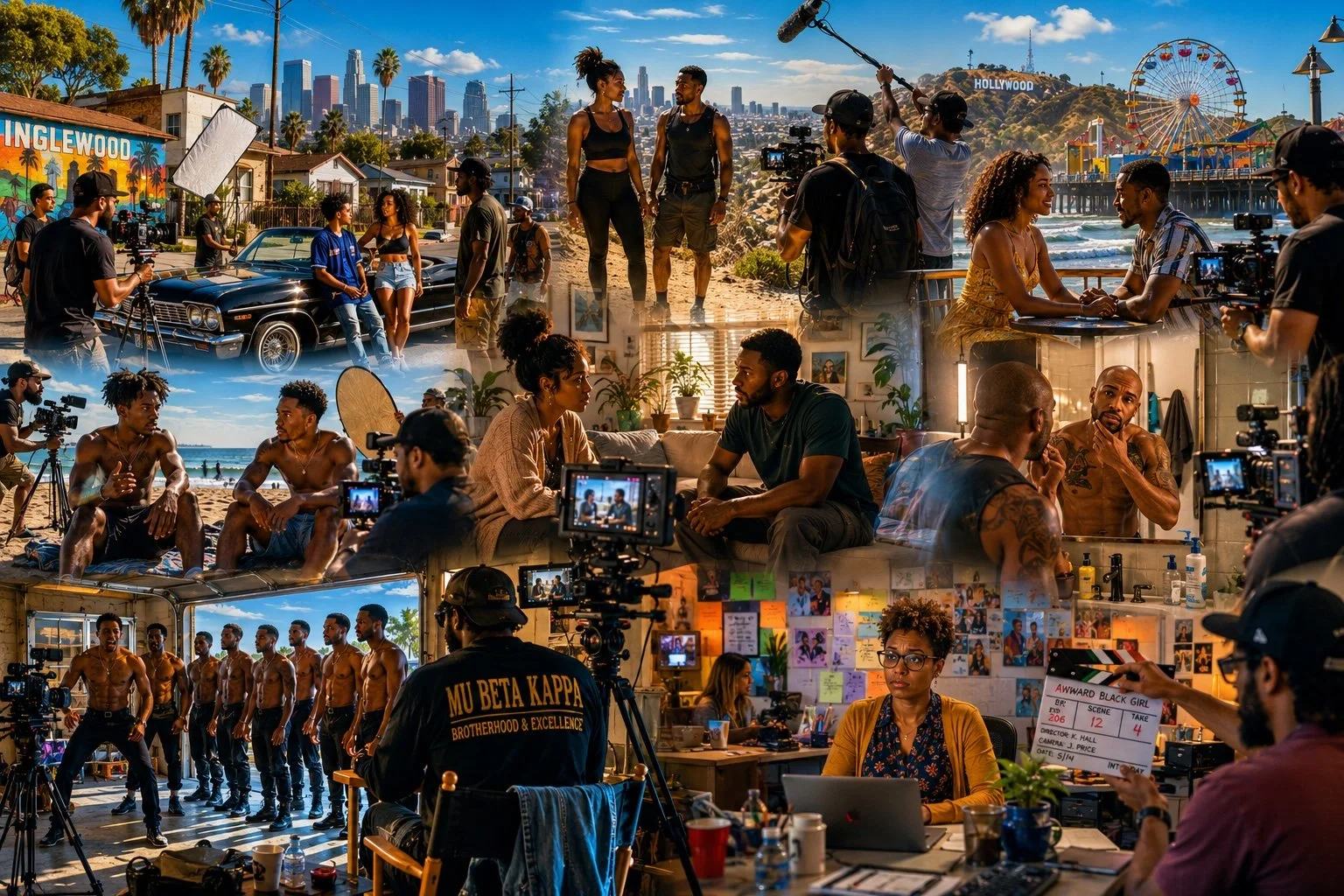
The answer would become one of the most important and least documented Black creative movements of the early twenty-first century. Known today as the Black Web Series Movement, it emerged during the late 2000s and early 2010s as Black creators increasingly turned toward digital platforms to tell stories that traditional institutions appeared less interested in financing, producing, or distributing. While the movement would eventually spread across multiple cities and countries, Los Angeles became its most concentrated hub, producing a dense ecosystem of creators, actors, producers, writers, journalists, and audiences whose collaborative energy resembled a localized cultural renaissance.
Yet before there was a movement, there was a generation. And before there was a generation, there was an ecosystem. To understand why hundreds of Black creators suddenly began building their own television shows, production companies, distribution systems, and audiences outside of Hollywood, it is first necessary to understand the world that taught them to dream of those careers in the first place.
For many Americans, the story of Black representation in film and television is often told as a story of steady progress. Each generation supposedly builds upon the gains of the previous one. More representation leads to more opportunity. More opportunity leads to more creators. More creators lead to more stories. The narrative is comforting because it suggests a kind of inevitability. Once a door has been opened, it remains open. The history of Black screen culture suggests something far more complicated.
The generation that would eventually build the Black Web Series Movement came of age during a period that now appears exceptional rather than typical. Throughout the 1990s, Black storytelling occupied a level of visibility across American media that had few historical precedents. Black audiences were not treated solely as niche audiences. They were actively courted. Networks competed for them. Advertisers pursued them. Studios invested in projects designed to reach them. This ecosystem was larger than any single show, network, filmmaker, or genre. It existed across multiple layers of American media simultaneously.
In television, Black audiences could move from The Fresh Prince of Bel-Air to Living Single, from Martin to Moesha, from The Parent ’Hood to The Steve Harvey Show, from Sister, Sister to The Parkers. UPN and WB built significant portions of their identities around Black audiences and Black-centered programming. BET functioned not merely as a television network but as a cultural institution, introducing audiences to artists, filmmakers, musicians, and public conversations often absent elsewhere.
The film landscape was equally influential. The success of filmmakers such as Spike Lee, John Singleton, Julie Dash, Charles Burnett, and The Hughes Brothers demonstrated that Black filmmakers could shape national conversations. Films such as Boyz n the Hood, Poetic Justice, Waiting to Exhale, Love Jones, Soul Food, Eve’s Bayou, and The Best Man occupied cultural space in ways that extended beyond box-office receipts. They provided models of authorship, possibility, and ambition.
Just as important were the forms of Black screen culture that rarely receive attention in contemporary discussions. Television movies. Youth programming. After-school specials. Cable productions. Music video storytelling. Regional independent filmmaking. These formats rarely dominate retrospectives, yet they provided employment, visibility, and creative opportunities for countless performers, writers, directors, and technicians. They also helped create the impression that Black storytelling existed throughout the media landscape rather than in isolated pockets.
The generation that would eventually build web series was not responding to a complete absence of representation. They were responding to the memory of abundance. They had seen a larger ecosystem. They had grown up believing that ecosystem was normal. And that assumption would prove enormously consequential. As the twentieth century gave way to the twenty-first, many of the structures that had helped sustain that ecosystem began to change. Some disappeared. Some consolidated. Some evolved into entirely different forms. Others remained but with diminished influence. What emerged was not a sudden collapse, but a gradual narrowing of the landscape that many aspiring Black creatives had expected to enter.
The Black Web Series Movement would eventually emerge from that narrowing. But first, the contraction itself must be understood.
When the Screens Started Going Dark
The disappearance of an ecosystem rarely feels like a disappearance while it is happening. Industries rarely announce that opportunities are shrinking. Networks do not issue press releases declaring that fewer pathways will exist for the next generation. Creative contractions tend to occur gradually, one cancellation, one merger, one strategic shift, one lost opportunity at a time.
The contraction of Black screen culture during the first decade of the twenty-first century followed a similar trajectory. Many of the institutions that had helped define the previous decade remained standing. BET still existed. Black films continued to be released. Black actors continued to work. Successful projects still emerged. Yet the ecosystem itself increasingly appeared thinner than it had only a few years earlier.
Television offers one of the clearest illustrations of this shift. The 1990s had produced a remarkable concentration of Black-centered sitcoms across multiple networks. By the early 2000s, many of those programs had ended and were not being replaced at the same rate. Industry observers and civil rights organizations noted the decline. The issue was not simply the cancellation of individual shows. The issue was that fewer Black-centered spaces appeared to be opening behind them. The ecosystem that had once seemed expansive increasingly appeared selective. Opportunities remained, but they no longer appeared abundant.
The shift extended beyond sitcoms. Television movies, once a significant component of network programming, steadily lost prominence within the entertainment landscape. Throughout previous decades, television movies had provided opportunities for actors, directors, and writers while also allowing networks to experiment with stories that might not justify theatrical release. As network priorities evolved and programming economics changed, those spaces became less central. The loss was subtle but meaningful. Every disappearing format represented one fewer entry point into the industry.
The same pattern could be observed in youth-oriented programming. For decades, after-school specials and similar forms of television storytelling had functioned as developmental spaces for performers and creators while introducing young audiences to stories often absent elsewhere. By the early 2000s, much of that infrastructure had vanished. Although these productions are rarely discussed alongside major films and television series, they formed part of a broader ecology of Black screen culture. Their disappearance contributed to the sense that the industry was becoming narrower rather than broader.
Theatrical filmmaking presented its own contradictions. The 2000s produced notable successes, including films such as Love & Basketball, Brown Sugar, Barbershop, ATL, and Hustle & Flow. Yet these successes often appeared as individual achievements rather than evidence of a thriving ecosystem. The generation that followed Spike Lee, John Singleton, Julie Dash, and Robert Townsend increasingly encountered an industry in which Black filmmakers continued to break through, but fewer sustained infrastructures appeared to exist around those breakthroughs. Success stories remained visible. Pathways remained less clear.
The industry’s structural realities reinforced this perception. Studies conducted by the UCLA Ralph J. Bunche Center, the Directors Guild of America, and later the USC Annenberg Inclusion Initiative documented persistent disparities in hiring, leadership, authorship, and representation throughout film and television. While individual success stories frequently received attention, the broader distribution of opportunity remained highly unequal. For many aspiring Black creatives, these realities were not abstract statistics. They were encountered through unanswered submissions, failed meetings, limited access, and the growing recognition that entry into the industry remained dependent upon a relatively small number of gatekeepers.
The result was a peculiar generational experience. Many young Black creatives had been raised on evidence that Black storytelling could thrive across multiple formats and platforms. Yet when they attempted to enter the industry themselves, they encountered a landscape that often appeared smaller than the one that had inspired them.
In 2026, Lazarus X (formerly Lamont Pierré), filmmaker and founder of BOA Collective (aka Band of Artists Filmmaking Collective — co-founded by Geno Brooks & Jared Wofford), later described this disconnect in stark terms: “I think that a lot of creators in the Black Web Series Revolution thought we were entering the industry of Spike Lee and John Singleton. But nobody told us that that could be non-existent. That’s part of what I think is important for people in the industry to tell the aspiring generations behind them because that’s important. That’s a really important detail. When they’re having panels and doing appearances and lectures and stuff like that, and they’re inspiring new generations behind them, they’re not completely telling them what the landscape might look like because they’re not being completely honest with them about what their current experience is looking like because the signs are sometimes there. Just like the people that are getting inspired by Ryan Coogler right now and they’re thinking, ‘I want to be a filmmaker because of that.’ Nobody’s telling those people that the landscape most likely is not going to look like that by the time you get there. So you need to keep that in mind.”
His observation points toward one of the central tensions that would eventually fuel the Black Web Series Movement. The creators who built the movement were not merely searching for visibility. They were searching for alternatives. They had inherited aspirations from a larger ecosystem while confronting the realities of a smaller one. The question increasingly became not how to enter the existing system, but whether another system could be built alongside it.
The Crack in the Wall
If the contraction of the industry created the conditions for the Black Web Series Movement, technology provided the opportunity. Movements require more than frustration. They require tools. Throughout the late 2000s, a series of technological shifts began altering the relationship between creators, production, distribution, and audiences. Individually, many of these developments appeared modest. Collectively, they transformed the economics of independent media.
For most of the twentieth century, filmmaking had been expensive. Professional cameras were expensive. Editing systems were expensive. Distribution was expensive. Even when talented filmmakers managed to produce work, reaching audiences often required access to institutions they did not control. The barriers were financial, technological, and structural. By the end of the 2000s, those barriers were beginning to weaken.
Perhaps the most significant shift occurred in production itself. A new generation of cameras dramatically reduced the cost of creating professional-looking content. The emergence of DSLR filmmaking, particularly cameras such as the Canon 5D Mark II and later the Canon 7D, altered expectations throughout independent filmmaking. Images that previously required substantially larger budgets suddenly became accessible to creators operating with limited resources. Affordable lighting equipment, digital editing systems, and improvements in audio technology further accelerated the trend.
The impact of these tools extended beyond aesthetics. They changed who could participate. A generation of filmmakers emerged that existed somewhere between amateur and professional production. They were not hobbyists. They were not studio-backed filmmakers. They occupied a new space made possible by technological accessibility. Working with borrowed equipment, limited crews, and small budgets, they could produce content that increasingly resembled professional television and film.
Production, however, was only half of the equation. The greater revolution involved distribution. For decades, distribution had functioned as one of the industry’s most powerful gatekeeping mechanisms. A creator might possess talent, skill, and completed work, but without access to distribution, audiences would never encounter it. Traditional media institutions controlled those pathways. Networks decided what aired. Studios decided what received theatrical releases. Cable channels determined what reached viewers’ homes.
Then YouTube arrived. When YouTube launched in 2005, few could have predicted the extent to which it would reshape media culture. The platform did not solve every problem facing independent creators. It did not provide sustainable revenue for most users. It did not eliminate gatekeeping entirely. What it did provide was visibility. For the first time, creators could publish work and potentially reach audiences without the approval of traditional institutions. A filmmaker no longer needed a television network to place a series before viewers. An actor no longer needed a casting director to create visibility. A writer no longer needed a studio executive to determine whether a story deserved an audience.
The significance of this shift cannot be overstated. For a generation of Black creatives already questioning traditional pathways into the industry, YouTube represented more than a website. It represented a crack in the wall. The platform’s limitations quickly became apparent. Visibility was not the same thing as ownership. Views were not the same thing as sustainability. Audiences could be reached, but monetization remained uncertain. Yet even with those limitations, creators recognized something important: distribution no longer belonged exclusively to the gatekeepers.
At the same time, social media platforms began reshaping audience relationships. Facebook enabled communities to form around projects. Twitter allowed creators to communicate directly with viewers. Blogs and emerging digital publications created new avenues for promotion and discussion. Traditional publicity infrastructures no longer possessed complete control over discovery. The tools were arriving. What remained uncertain was whether creators could transform those tools into something larger than individual projects. What emerged next was not merely a collection of web series. It was the beginning of an alternative creative economy. A generation that had spent years waiting for permission increasingly decided to proceed without it.
Nobody Called It a Movement Yet
The earliest architects of the Black Web Series Movement did not know they were building a movement. Most believed they were simply trying to get work made. Historical movements often appear far more organized in retrospect than they felt in the moment. Looking backward, it is possible to identify trends, common objectives, shared frustrations, overlapping aesthetics, and eventual consequences. Living through those same events often feels far less coherent. The creators who began producing Black web series during the late 2000s and early 2010s were not operating from a common manifesto. There was no governing body. There was no central organization. There was no agreed-upon strategy for transforming Black media. There were simply creators confronting similar problems at roughly the same time, often with similar urgency, but not always with the same ambitions.
What connected them was not a single genre or unified ideology, but a set of shared conditions. They were young enough to understand the internet as a natural space for discovery, frustrated enough with the industry to stop waiting for permission, and resourceful enough to treat scarcity as a production model. Shadow and Act recognized this almost in real time. In 2012, the site introduced its “Finding the New Black” interview series by identifying a “new generation of talent within black film and TV,” a group it described as young, often formally trained, moving between film, television, and new media, and “disillusioned with Hollywood” enough that they did not rely solely on the studio system to get their work made or seen.[1] That observation matters because it captures the movement before it hardened into mythology. These were not merely internet hobbyists. They were filmmakers, writers, producers, actors, and company-builders trying to create alternate routes around an industry that still rationed access.
Los Angeles Invents a New Harlem
Los Angeles became the most concentrated site of that experimentation. The city already possessed an unusual density of Black actors, writers, directors, cinematographers, editors, producers, and assistants trying to build careers within or near the entertainment industry. Some had representation. Some had short films. Some had credits. Some had film-school training. Some had television-adjacent jobs. Many had ambition far larger than their access. What the web offered was not simply a place to upload work. It offered a way to test whether audiences would gather around stories that traditional gatekeepers had not yet chosen to validate.
The LA ecosystem was not built by one person or one company. It was built by interlocking nodes. Issa Rae’s The Misadventures of Awkward Black Girl became the most visible breakthrough, but it was part of a wider field that included Black&Sexy TV, founded by Dennis Dortch, Numa Perrier, Brian Ali Harding, and Jeanine Daniels; Brown Paper Dolls, the collective behind Milk + Honey; Lena Waithe’s early digital and short-form work, including Twenties and her participation in the broader web-creator circle; Kim Williams’ The Unwritten Rules; Jahmela Biggs’ First; Matthew Cherry’s Almost 30; Robert Townsend’s Diary of a Single Mom; BOA Collective, with projects including Geno Brooks’ Black Boots and Lamont Pierre’s Miles + Cal; and other projects that circulated through YouTube, Vimeo, blogs, festivals, and social media.
The field was broader than the handful of names most often remembered. That breadth is crucial because the essay’s argument depends on seeing the LA moment not as an origin story for a few later celebrities, but as a creative ecology. Shadow and Act’s 2012 interview with Lena Waithe provides one of the clearest pieces of evidence that creators were aware of one another and actively forming networks. Waithe described being part of “a collective” that included herself, Dennis Dortch and Numa Perrier of Black&Sexy TV, Brown Paper Dolls of Milk + Honey, Issa Rae of Awkward Black Girl, and the creators of The Brown Betties Guide. She said Dennis Dortch had brought them together as a group of Black creators doing online content, called CTRL.[2] That detail is essential. It confirms that the ecosystem was not merely imagined after the fact. Some of its architects were already attempting to name, organize, and cross-pollinate it while it was happening.
Waithe’s interview also reveals the competing agendas inside the movement. She was working in television, writing viral digital content, directing shorts and web series, participating in independent film, and helping create new initiatives at the Writers Guild. Her description of her work was not linear. It was scattered, multi-platform, and organic. She said the many projects she was involved in “came about so organically,” adding, “It’s all in the doing.”[3] That phrase could describe the entire movement. The work did not wait for ideal conditions. It moved through whatever channels were available.
Black&Sexy TV became one of the most important institutions in this environment because it treated web series not only as calling cards, but as a brand architecture. Dennis Dortch had already directed A Good Day to Be Black & Sexy, and Black&Sexy TV extended that sensibility into serial digital storytelling. In 2011, Shadow and Act covered The Couple, describing Dennis Dortch’s “Black And Sexy” brand as using the web as its release platform at BLACK&SEXY.TV.[4] The project, created by Jeanine Daniels, Dennis Dortch, and Numa Perrier, and starring Perrier and Desmond Faison, joined earlier Black&Sexy work such as The Number, and helped build a world of relationship-driven, intimate, contemporary Black storytelling.
By 2012, Shadow and Act was already framing Black&Sexy TV’s expansion as a broader creator opportunity. When The Couple began moving toward a feature adaptation, the site observed that it was “a great time to be a content creator” because creators were no longer limited to one or two platforms and could imagine a web series, film, television show, graphic novel, and more existing around the same property.[5] This was not merely a production update. It was an early articulation of a new media logic: the creator as brand, the series as expandable IP, the audience as portable, and the web as proof of concept.
Issa Rae’s trajectory demonstrated a related but distinct model. Awkward Black Girl began with a specific representational intervention: a Black female protagonist whose awkwardness, interiority, and social discomfort did not fit the limited templates available on television. Shadow and Act’s later profile of Rae and ColorCreative emphasized that the Awkward Black Girl Kickstarter campaign raised more than $56,000 in 2011 and quoted its premise: “Television today has a very limited scope and range in its depictions of people of color… We want to change that.”[6] The success of that campaign showed that audiences were not merely consuming these works passively. They were funding them, circulating them, defending them, and helping transform them into leverage.
Rae’s later development of Issa Rae Productions and ColorCreative also shows how quickly the movement began to shift from individual web series to infrastructure. Shadow and Act described ColorCreative.TV as a platform designed to introduce half-hour pilots by underrepresented talent and noted that Rae’s YouTube channel had become home to several series beyond Awkward Black Girl.[7] In other words, Rae did not only create a breakout series. She built a channel that could function as an incubator for other creators. This is central to understanding the LA Renaissance. The most important figures were not only making shows. They were experimenting with systems.
The collaboration between Issa Rae Productions and Black&Sexy TV made that system-building visible. In 2013, Shadow and Act covered the second season of Roomieloverfriends, identifying it as a Black&Sexy TV series created by Dennis Dortch and Numa Perrier and executive produced by Issa Rae through Issa Rae Productions.[8] The post praised the creators for “building a strong library of work” and giving Black audiences varied experiences ignored by the mainstream.[9] This language is important because it shows that Shadow and Act was not simply reviewing episodes. It was interpreting the moment, naming the labor of library-building, and recognizing that the web-series ecosystem was producing range where mainstream television had created scarcity.
Other LA projects widened the field. Brown Paper Dolls’ Milk + Honey, executive produced by Idris Elba, focused on Black women navigating ambition, friendship, and love in Los Angeles. Kim Williams’ The Unwritten Rules used the workplace comedy to explore the everyday absurdities of being Black in predominantly white professional spaces. Shadow and Act covered it as a series about “the comedic realities of being an African-American in a predominantly white workplace.”[10] Jahmela Biggs’ First, distributed through Issa Rae’s platform, brought another strand of intimate Black romantic storytelling into the ecosystem. Matthew Cherry’s Almost 30, covered by Shadow and Act in 2013, showed how filmmakers moving between features and digital projects were using the web as another site of experimentation.[12]
Robert Townsend’s Diary of a Single Mom occupies a special place in this history because it connected the web-series movement to an earlier generation of Black film and television labor. Directed by Townsend and starring Monica Calhoun, Leon, Billy Dee Williams, Richard Roundtree, and Valery Ortiz, the project was described by Shadow and Act as a “web series-turned-feature film.”[13] Its presence complicates any easy narrative that the web-series movement belonged only to unknown outsiders. Established Black filmmakers and actors were also testing digital-first models. The movement was not only youth rebellion. It was also a bridge between generations.
The broader field extended beyond Los Angeles, but LA’s particular density made it feel different. In New York, events such as “Black, Brown & Digital” at MIST Harlem brought together creators of color working in online series and explicitly framed the digital space as a response to the lack of diversity on television. The event’s press language called the moment “the new DIY media culture brewing online amongst people of color” and said its goal was to counter lack of diversity in front of and behind the camera.[14] Its panel included creators such as Al Thompson of Lenox Ave., Tony Clomax of 12 Steps to Recovery, Stacey Muhammad of For Colored Boys, A.V. Rockwell of Open City Mixtape, and others.[15] That event shows the Black web series movement was larger than LA. But LA remained the most concentrated renaissance because proximity allowed creators, crews, actors, and audiences to repeatedly encounter one another.
This is where the Harlem Renaissance comparison becomes useful, not as a claim of identical historical scale, but as a structural analogy. The Black LA Web Series Renaissance was defined by proximity, overlapping labor, competing ambitions, shared audiences, cross-pollination, and the sense that people were building near one another even when they were not always building together. Like Harlem, LA was not a utopia. It contained rivalry, ego, scarcity, uneven visibility, and competing agendas. But those tensions did not negate the renaissance. They helped produce its energy.
Everybody Knew Everybody
The acting talent that emerged from the Black LA Web Series Renaissance provides some of the clearest evidence that the ecosystem functioned as an incubator rather than simply a collection of shows. Web series gave actors recurring roles, lead roles, footage, audience recognition, and creative relationships at a moment when traditional opportunities remained limited.
Will Catlett became one of the most recognizable faces of the era through Black&Sexy TV’s That Guy, where he starred as Mike, and Issa Rae’s First, where he played Charles. Those projects helped establish a screen presence that would later carry into HBO’s Love Is, HBO’s Black Lightning, Netflix’s True Story, Apple TV+’s Constellation, and films including A Thousand and One and Abigail. Ashley Blaine Featherson emerged through Black&Sexy TV’s Hello Cupid, which she co-created with Lena Waithe and in which she starred as the lead character. She later appeared in Roomieloverfriends before moving into mainstream projects including Netflix’s Dear White People. Courtney Burrell became one of the renaissance’s most visible crossover performers. Within the Black&Sexy TV ecosystem he starred as Julian in Chef Julian, one of the network’s signature series. He also served as the lead actor in BOA Collective’s Black Boots, making him a direct link between two major creative nodes within the Los Angeles ecosystem. He later appeared in projects including Insecure, The Game, Too Close to Home, A La Carte, and Tyler Perry’s A Madea Family Funeral. KJ Smith gained early visibility through Geno Brooks’ web series The Therapist, one of the most prominent relationship dramas circulating within the Los Angeles web-series ecosystem. She would later go on to network and cable television success, becoming widely known through projects such as Sistas, The Family Business, and other television roles. Michelle Mitchenor’s connection to the renaissance also came through BOA Collective’s Black Boots, where she served as one of the series’ principal leads opposite Courtney Burrell. Her later career would include major television roles in Lethal Weapon, Chi-Raq, and other studio and network productions.
What is notable is not merely that these performers found success. It is where that success was cultivated. Their careers were developed inside creator-built ecosystems long before many traditional industry gatekeepers recognized their value. The same web-series environment that produced audiences also produced talent. In that sense, the Black LA Web Series Renaissance was not simply generating content. It was generating careers.
The Site That Kept the Receipts
The press ecosystem was equally important. Shadow and Act, founded by Tambay Obenson in 2009, became one of the central archives and amplifiers of the movement. Obenson later wrote that Shadow and Act had spent eight years supporting “the mostly ignored work by and/or about people of African descent” and showcasing Black talent in front of and behind the camera.[16] This is not a minor detail. For many Black web series, mainstream entertainment media offered little to no coverage. Shadow and Act covered trailers, premieres, crowdfunding campaigns, feature adaptations, platform launches, festival appearances, and creator interviews. It gave the work visibility and seriousness.
Aymar Jean Christian’s scholarship confirms the importance of that media infrastructure. In Open TV, Christian writes that niche blogs were crucial in publicizing web series and specifically identifies Shadow and Act and Clutch as pivotal in showcasing Black web series.[17] His work also situates web series as a response to exclusions in legacy television development, arguing that producers excluded from traditional systems used the internet to create new models for financing and narrating stories.[18] This scholarly framing supports what creators were living: the web was not simply a novelty. It was a workaround, an archive, a laboratory, and a counter-public.
By the early 2010s, Los Angeles had become more than a city producing web series. It had become an incubator. Creators were building projects, brands, production companies, channels, and business models. They were experimenting with audience relationships, crowdfunding, direct distribution, and intellectual property. Some wanted Hollywood to notice. Some wanted Hollywood to fund them. Some wanted to bypass Hollywood entirely. Most wanted some combination of visibility, ownership, sustainability, and creative freedom.
The movement was still fragmented. Its participants often worked independently of one another. It contained collaboration and competition, generosity and ego, shared purpose and private ambition. But that is how renaissances often work. They are rarely as unified as later histories want them to be. What made the Black LA Web Series Renaissance significant was not that everyone had the same goal. It was that so many creators, in the same city, under the same industry pressure, using the same emerging tools, began creating their own lanes at once. Every completed season challenged assumptions about who could produce television. Every growing audience challenged assumptions about demand. Every creator-owned platform challenged assumptions about distribution. Every actor who moved from one digital project to another proved that the ecosystem was developing talent. Every Shadow and Act post made the work harder to ignore. If the industry would not create enough room, perhaps room could be created elsewhere.
More Than Content
The Black Web Series Movement was not merely a creative experiment. It was also a business experiment. Many retrospective accounts of the era focus almost exclusively on storytelling. They celebrate breakthrough series, memorable characters, and creators who eventually secured Hollywood opportunities. What often receives less attention is the fact that many of the movement’s participants were simultaneously attempting to solve a second problem: sustainability.
Making a web series was difficult. Making a second season was even harder. The earliest years of the movement were fueled largely by unpaid labor, favors, borrowed equipment, volunteer crews, and personal sacrifice. Actors worked for little or no money. Writers worked for little or no money. Directors, editors, cinematographers, and producers often worked under similar conditions. The economics rarely made sense. The hope was that visibility would eventually create opportunity. Yet visibility alone could not sustain an ecosystem. As audiences grew, creators increasingly confronted a fundamental question: If these projects were attracting viewers, where was the money supposed to come from?
YouTube offered distribution, but for most independent creators it did not offer meaningful financial stability. The platform was revolutionary because it allowed creators to reach audiences without traditional gatekeepers. It was less revolutionary as a business model. Advertising revenue was inconsistent. Ownership remained limited. Platforms controlled discovery. Audiences belonged as much to the platform as to the creator. For creators who had already spent years navigating gatekeepers, this raised an uncomfortable possibility. Had they escaped one system only to become dependent upon another?
The search for alternatives produced one of the most overlooked chapters of the Black Web Series Movement. Rather than treating web series exclusively as promotional tools, some creators began asking whether audiences would directly support the work itself. This question led to experimentation with subscription platforms, direct sales, crowdfunding, memberships, and creator-owned distribution.
Black&Sexy TV became one of the movement’s most important proof-of-concept examples. Rather than relying exclusively on YouTube advertising revenue, the company experimented with direct-to-consumer models through Vimeo’s emerging on-demand infrastructure. The results were significant enough that industry observers began paying attention. According to Vimeo’s own case studies, Black&Sexy TV eventually generated more revenue through direct audience support than it had through traditional YouTube monetization. The implications extended far beyond a single company. If audiences were willing to pay creators directly, an entirely different economic future became imaginable.
The shift represented more than a new revenue stream. It represented a new philosophy: ownership, control, direct audience relationships, and the ability to build an asset rather than merely generate views. Other creators watched carefully. Companies such as BOA Collective would later pursue similar approaches, recognizing that the future of independent Black media might depend not simply upon attracting attention but upon owning distribution. Vimeo On Demand, followed by VHX and later creator-owned streaming platforms, introduced possibilities that had rarely existed for independent filmmakers. For the first time, creators could begin imagining themselves not merely as content suppliers for larger institutions, but as institutions themselves.
This development marked an important divergence within the movement. Not everyone wanted the same thing. Some creators viewed web series primarily as a pathway into Hollywood. Their goal was development deals, studio projects, television staffing positions, agency representation, and traditional industry careers. Others increasingly viewed the movement as an opportunity to build independent media businesses. These ambitions were not mutually exclusive. Many creators pursued both simultaneously. The question facing the movement was no longer simply how to get noticed. The question was what happened after creators got noticed. Would the movement become a farm system for Hollywood? Or would it become the foundation of an alternative Black media infrastructure? The answer would shape the future of the renaissance itself.
Hollywood Comes Calling
The Black Web Series Movement spent much of its early life existing just outside the center of the traditional entertainment industry. Hollywood was not entirely unaware of what was happening. Agents, managers, development executives, and producers watched from a distance. Yet for several years the movement occupied a liminal space, visible enough to attract curiosity but not yet large enough to force a response. Creators were producing work with limited budgets, volunteer crews, borrowed equipment, and little institutional support. What made the movement remarkable was not merely that the work existed, but that audiences were finding it. Black creators were building communities, launching careers, and generating cultural conversation without the approval of the networks and studios that had historically controlled access to viewers.
By the early 2010s, however, the evidence had become increasingly difficult to ignore. Issa Rae’s The Mis-Adventures of Awkward Black Girl had evolved from a low-budget YouTube series into a cultural phenomenon, attracting a devoted audience and eventually becoming the foundation for HBO’s Insecure. Critics and historians now routinely identify Awkward Black Girl as one of the clearest demonstrations that Black creators could use the internet to build audiences independently of traditional television institutions. The success of the series was significant not simply because it was popular, but because it challenged long-standing assumptions about what audiences wanted. For years, industry executives had often framed Black-centered stories as niche content with limited commercial appeal. Yet Rae’s work demonstrated that audiences would enthusiastically support stories that traditional gatekeepers had frequently ignored.
Rae herself has reflected on how Awkward Black Girl became a gathering point for a broader creative community. Looking back on the series, she described how other creators began reaching out to her because they were attempting to build similar projects and alternative pathways for their work. The success of the series eventually led her toward creating additional opportunities for underrepresented creators through ventures such as ColorCreative, which she later described as a response to the industry’s continued inability to consistently develop diverse voices. The trajectory from Awkward Black Girl to Insecure was not simply the story of one creator’s rise. It was evidence that the web could function as a proving ground for talent, audience development, and intellectual property.
Hollywood’s response followed a familiar pattern. As audiences grew and attention intensified, development deals began to appear. Agency representation followed. Meetings followed. The relationship between the movement and the entertainment industry entered a new phase. Creators who had spent years building independent projects suddenly found themselves in conversations with the institutions they had initially worked around. For many, this represented a long-awaited validation. Years of self-financing, crowdfunding, volunteer labor, and personal sacrifice appeared to be paying off. Development deals offered resources, visibility, and access to larger audiences. They promised a level of stability that independent production rarely provided.
The trajectory of Black&Sexy TV illustrates both the opportunities and tensions that emerged during this period. Founded by Dennis Dortch, Numa Perrier, Brian Ali Harding, and Jeanine Daniels, Black&Sexy TV had built an impressive digital audience through projects such as The Couple, The Number, Roomieloverfriends, and other relationship-centered dramas and comedies. By 2014, according to Aymar Jean Christian’s research, the company was developing The Couple with HBO and Spike Lee attached as an executive producer. Yet even as those opportunities emerged, Perrier expressed caution about placing too much faith in Hollywood’s interest. “We aren’t putting all our eggs in that basket,” she explained, reflecting an awareness that development deals and institutional recognition did not necessarily guarantee long-term sustainability.
That tension reveals one of the central contradictions of the Black Web Series Movement. The creators who had spent years building alternative systems were now being invited into the very institutions they had learned to circumvent. Some viewed this as the movement’s ultimate victory. Others worried it might become its greatest vulnerability. The concern was never whether individual creators would succeed. Many did. The concern was whether the broader ecosystem would survive the success of its most visible participants.
The Fork in the Road
At the same time, some creators were pursuing a different vision altogether. Rather than viewing web series primarily as stepping stones into Hollywood, they were experimenting with the possibility of creator-owned media infrastructure. Black&Sexy TV became one of the most important examples of this alternative path. After building a substantial audience through YouTube, the company embraced direct-to-consumer distribution through Vimeo’s subscription technology. The results were striking. According to Vimeo’s own case studies, Black&Sexy TV generated approximately $35,000 in a single month through its subscription model, roughly equivalent to what the company had previously earned in an entire year from YouTube advertising revenue.
The significance of those numbers extended far beyond one company. They suggested that independent creators might be able to build sustainable businesses by owning their audiences rather than renting access to them through advertising platforms. Creator-controlled distribution, subscription revenue, and direct audience relationships represented a fundamentally different vision of the future. Companies such as Black&Sexy TV and later BOA Collective were not merely producing content. They were experimenting with ownership.
This divergence would become increasingly important as the decade progressed. Some creators saw the web as a pathway into Hollywood. Others saw it as the foundation for a new Black media economy. Many attempted to pursue both simultaneously. For a brief period, both possibilities appeared viable. The Black Web Series Movement had demonstrated that Black creators could build audiences, launch careers, create intellectual property, and generate revenue without waiting for institutional permission. The question was no longer whether Black creators could create alternatives. The question was what would happen once Hollywood decided it wanted some of what those creators had built.
How a Renaissance Disappears
One of the most difficult things about studying creative movements is that they often begin to disappear at the exact moment they appear to be succeeding. From the outside, the middle of the 2010s looked like a triumph for many of the creators associated with the Black Web Series Movement. Development deals were being signed. Television opportunities were expanding. More executives were expressing interest in Black creators. Industry publications were paying attention. The language that many web-series creators had been using for years about representation, audience-building, creator ownership, and direct engagement with viewers was beginning to appear in mainstream entertainment conversations. If one measured success through visibility, there was reason for optimism.
There was also evidence that the movement had fundamentally altered how the industry thought about talent development. Issa Rae’s The Mis-Adventures of Awkward Black Girl, which premiered on YouTube in 2011, had become one of the most visible proof-of-concept stories of the era. The series built a devoted audience outside of traditional television and eventually became the foundation for HBO’s Insecure, a trajectory that industry observers repeatedly pointed to as evidence that creator-led digital projects could become premium television properties. HBO itself publicly described Awkward Black Girl as the project that “helped pave the way” for Insecure.
What is often forgotten is that Rae herself did not initially view the success of Awkward Black Girl solely as an individual achievement. Reflecting on the period years later, she described how creators began reaching out to her after seeing the series gain traction. “‘What you’re doing is amazing. We’re also trying to do the same thing,’” people would tell her. Those interactions eventually led to collaborative partnerships, additional series, and the development of a broader channel of programming. Rae later explained that this experience helped shape her belief that audiences could be built first and that networks might come afterward, an idea that would eventually influence the creation of ColorCreative and its efforts to support underrepresented creators.
The same pattern was visible elsewhere throughout the ecosystem. Black&Sexy TV had spent years building an audience through series such as The Couple, Hello Cupid, Roomieloverfriends, and That Guy. By the mid-2010s, the company was no longer operating solely as an independent digital collective. According to scholar Aymar Jean Christian, Black&Sexy TV was developing The Couple with HBO, with Spike Lee attached as an executive producer. Yet even while pursuing those opportunities, co-founder Numa Perrier expressed caution about depending too heavily on institutional validation. As Christian records in Open TV, Perrier explained, “We aren’t putting all our eggs in that basket.” The statement reflected a broader awareness among some creators that development deals could create opportunities while also creating new forms of dependence.
This tension sat at the center of the movement’s next phase. The creators who had spent years building alternatives to traditional gatekeeping structures were now being invited into those very structures. For many, this was precisely the outcome they had been working toward. Most had spent years financing productions through personal sacrifice, crowdfunding campaigns, volunteer labor, and borrowed resources. Development deals offered money, visibility, distribution, and the possibility of reaching audiences at a scale that independent production rarely allowed.
Yet another possibility had also emerged. At the same moment that Hollywood was becoming interested in web-series creators, some creators were experimenting with an entirely different future. Rather than viewing the internet as a pathway into traditional media institutions, they were beginning to explore whether creator-owned distribution systems could become viable businesses in their own right. Black&Sexy TV became one of the most influential examples. After building an audience through free online distribution, the company moved toward subscription-based streaming through Vimeo’s emerging direct-to-consumer infrastructure. According to Vimeo’s own case studies and later scholarship, the company generated approximately $35,000 in a single month through subscriptions, a figure reported to be roughly equivalent to what it had previously earned from a year of YouTube advertising revenue.
That number represented more than a business milestone. It suggested that Black creators might not need to choose exclusively between obscurity and institutional dependence. A third option was becoming imaginable: ownership. For a brief moment, both futures appeared possible. The Black Web Series Movement had demonstrated that Black creators could build audiences, launch careers, develop intellectual property, and generate revenue without waiting for traditional permission. The question was no longer whether Black creators could create alternatives. The question was what would happen once Hollywood decided it wanted some of what those creators had built.
The tension between institutional integration and ecosystem-building became more visible as the decade progressed. By the middle of the 2010s, the Black Web Series Movement had already demonstrated that Black creators could build audiences without network approval, launch careers outside traditional development systems, and create intellectual property that attracted significant public attention. What remained unclear was whether these successes would strengthen the broader ecosystem or primarily benefit the individuals who achieved them.
The movement had always been larger than its most visible participants. Its strength came not simply from individual creators, but from a dense network of actors, writers, directors, bloggers, producers, festivals, audiences, and platforms. Shadow and Act covered projects across the ecosystem. Actors appeared in multiple series. Creators collaborated across company lines. Black&Sexy TV, Issa Rae Productions, BOA Collective, Brown Paper Dolls, Matthew Cherry, and many others were building work simultaneously. The value of the movement emerged not only from individual projects but from the collective energy generated by their coexistence.
Yet as Hollywood’s interest increased, attention naturally gravitated toward breakout figures. Issa Rae’s trajectory became the most visible example. What began as The Mis-Adventures of Awkward Black Girl on YouTube ultimately led to HBO’s Insecure. The transition was so significant that many later accounts of Rae’s career treat the web series as the direct precursor to her HBO success. HBO, media profiles, and later historical accounts consistently identified Awkward Black Girl as the project that established Rae’s audience and helped create the pathway toward premium television.
Rae’s success was unquestionably deserved. At the same time, it illustrates a broader historical pattern. The entertainment industry increasingly recognized the value of creators who had already proven their ability to build audiences independently. In effect, the movement had become a talent-development system operating outside traditional television. The industry did not invent these creators. It discovered them after they had already demonstrated their value.
A similar dynamic unfolded around Black&Sexy TV. By 2014, the company had attracted enough attention that HBO was developing The Couple with Spike Lee attached as an executive producer. Yet even while pursuing that opportunity, Black&Sexy TV co-founder Numa Perrier expressed caution about depending too heavily on Hollywood’s interest. As documented by media scholar Aymar Jean Christian, Perrier stated, “We aren’t putting all our eggs in that basket.” That quote now reads as one of the most revealing statements of the era. It reflects an awareness that development deals and institutional recognition did not necessarily solve the larger question facing the movement. Success inside Hollywood and the construction of independent Black media infrastructure were not always the same project.
Black&Sexy TV’s transition toward subscription-based distribution demonstrated that alternative business models were possible. According to Vimeo’s own case studies, the company generated approximately $35,000 in a single month through Vimeo’s OTT subscription infrastructure, roughly equivalent to what it had previously earned from an entire year of YouTube advertising revenue. The significance of that figure extended beyond one company. It suggested that independent Black creators might be able to build sustainable businesses through direct audience relationships rather than relying exclusively on advertising revenue or studio approval. Similar questions were being explored throughout the ecosystem as creators experimented with Vimeo On Demand, VHX, crowdfunding, subscriptions, and creator-owned platforms. For a brief period, it appeared possible that the movement might evolve into something larger than a collection of web series. It might become a parallel media economy.
Yet building institutions requires different resources than building projects. Historically, cultural renaissances often produce lasting infrastructure only when collective institutions emerge alongside individual success. The Harlem Renaissance generated journals, publishing relationships, artistic networks, and cultural organizations. The Black Arts Movement produced theaters, presses, schools, and community institutions. The Black Web Series Movement unquestionably produced talent, audiences, and influential work. What remains less clear is whether it generated institutions at the same scale.
Meanwhile, the broader industry was absorbing many of the movement’s innovations. Creator-led brands became increasingly valuable. Proof-of-concept projects became a common development strategy. Personal audiences became marketable assets. Streamers and studios increasingly sought creators who could demonstrate direct relationships with viewers. Many of the ideas that web-series creators had been experimenting with for years gradually became part of mainstream entertainment logic. As Christian argues in Open TV, independent digital creators were pioneering alternative forms of television production, financing, distribution, and audience engagement long before many of those practices became widely accepted.
In this sense, the movement succeeded beyond many of its participants’ expectations. The industry learned from it. The more complicated question is whether it remembered it. As individual creators achieved success, the collective story became harder to see. Public memory increasingly focused on the creators who crossed into mainstream institutions rather than the ecosystem that had helped produce them. The innovations survived. Many of the careers survived. Yet the broader movement gradually receded from view.
The Black LA Web Series Renaissance did not disappear through a single collapse, scandal, or public failure. It dispersed. Some creators entered Hollywood. Some remained independent. Some built companies. Some changed careers. Some continued producing work outside the spotlight. The concentrated energy that had once existed within a relatively dense creative ecosystem slowly spread across multiple directions. Historically, that is often how renaissances end. Not through defeat. Through diffusion.
The Future Forgot Its Parents
One of the peculiar ironies of the Black Web Series Movement is that it helped shape the future while becoming increasingly absent from the stories that future tells about itself. Many of the practices that define contemporary entertainment culture were visible within the movement years before they became industry orthodoxy. Creator-led brands. Direct audience engagement. Crowdfunding. Proof-of-concept development. Creator-owned intellectual property. Subscription-supported distribution. Multi-platform storytelling. Community-driven promotion. Today these practices are widely recognized as standard features of the media landscape. During the late 2000s and early 2010s, they were being actively tested by Black creators working largely outside the attention of major institutions. Scholar Aymar Jean Christian argues that digital television provided a space for producers excluded from traditional development systems to experiment with new forms of financing, production, distribution, and audience engagement. In many respects, the Black Web Series Movement functioned as a laboratory for precisely those innovations.
Yet contemporary discussions of media history often remember the outcomes more readily than the ecosystem that produced them. Individual creators are remembered. Individual success stories are remembered. What is less frequently remembered is the dense network of relationships, collaborations, experiments, failures, audiences, platforms, and institutions that made those successes possible. The movement’s most visible participants are often discussed as exceptional individuals rather than as members of a broader creative ecology.
This is one reason the Black LA Web Series Renaissance deserves particular attention. While the larger Black Web Series Movement extended across multiple cities and regions, Los Angeles developed a unique density of creators, actors, producers, writers, editors, bloggers, and audiences whose proximity generated a level of creative cross-pollination that resembles other historical artistic renaissances. Issa Rae, Black&Sexy TV, BOA Collective, Brown Paper Dolls, Matthew Cherry, Kim Williams, Jahmela Biggs, Lena Waithe, and many others were not merely producing isolated projects. They were working within overlapping creative networks. Actors circulated between productions. Creators collaborated, competed, advised one another, appeared on panels together, and built audiences that frequently crossed project boundaries. The significance of the renaissance emerged not from any single show but from the concentration of activity itself.
The comparison to the Harlem Renaissance should be approached carefully. The historical circumstances were different. The scale was different. The political conditions were different. Yet the comparison remains useful because both movements were characterized by creative density, overlapping networks, competing ambitions, and a collective attempt to expand the possibilities of Black cultural production. Neither movement was unified. Neither movement was free from rivalry, ego, or disagreement. Both generated energy precisely because so many talented people were working in close proximity while pursuing different visions of success.
The role of media infrastructure was equally important. The Harlem Renaissance benefited from newspapers, magazines, publishers, salons, and intellectual institutions that documented and amplified the work being created. The Black Web Series Movement developed its own forms of infrastructure. Among the most important was Shadow and Act. Founded by Tambay Obenson in 2009, Shadow and Act became one of the movement’s central chroniclers. At a time when mainstream entertainment journalism devoted relatively little attention to independent Black web series, the site consistently covered trailers, crowdfunding campaigns, premieres, creator interviews, development announcements, festival appearances, and industry analysis. In his announcement regarding Shadow and Act’s acquisition by Blavity in 2017, Obenson reflected on eight years of supporting “the mostly ignored work by and/or about people of African descent” and providing visibility to Black talent working in front of and behind the camera.
It is difficult to overstate the importance of that labor. Historical memory does not preserve itself. Movements survive because someone documents them. Without Shadow and Act, a significant portion of the archive surrounding the Black Web Series Movement might have been lost entirely. The site did more than report on the movement. It helped create the conditions under which the movement could see itself as a movement.
The relative absence of this history from broader public memory raises larger questions about how Black cultural innovation is remembered. Historically, Black creative movements have often generated ideas, aesthetics, and institutions that later become absorbed into mainstream culture. The innovations survive. The collective story becomes harder to see. The Black Web Series Movement appears to fit this pattern. Creator-led development became commonplace. Direct audience engagement became standard. Streaming platforms increasingly embraced creators with existing communities. Yet the ecosystem that helped pioneer many of these approaches remains far less visible than the innovations themselves.
The Unfinished Experiment
This is not simply a matter of historical recognition. It is also a question of future possibility. Every generation inherits stories about what is possible. The generation that built the Black Web Series Movement grew up watching the Black television and film ecosystem of the 1990s. Those images shaped their ambitions, even as the industry they entered looked dramatically different from the one that inspired them. In response, they built something new.
The next generation faces a different challenge. Many aspiring creators now encounter a media landscape dominated by streaming platforms, algorithms, social media metrics, and increasingly concentrated corporate ownership. The Black Web Series Movement offers an alternative history. It demonstrates that creators do not always have to wait for institutions to create opportunities. Communities can build audiences. Artists can create infrastructure. Independent ecosystems can emerge under conditions that appear unfavorable.
At the same time, the movement also offers a cautionary lesson. Building projects and building institutions are not the same task. The Black Web Series Movement succeeded spectacularly at proving that Black creators could generate audiences, careers, intellectual property, and cultural influence outside traditional gatekeeping systems. The more difficult challenge was transforming those successes into durable collective infrastructure capable of surviving beyond the movement’s peak years.
Perhaps that is the unfinished part of the story. The Black Web Series Movement should not be understood merely as a precursor to contemporary Black television, nor simply as a launching pad for a handful of successful careers. It was a large-scale experiment in Black cultural self-determination during the digital age. It asked whether creators could build their own pathways when existing pathways proved insufficient. For a remarkable period of time, the answer appeared to be yes. The fact that the experiment remains unfinished does not diminish its significance. If anything, it makes remembering it even more important.