The Only Black Kid in the Class: Memoir, Critique, and the Future Design of Black Intellectual Infrastructures
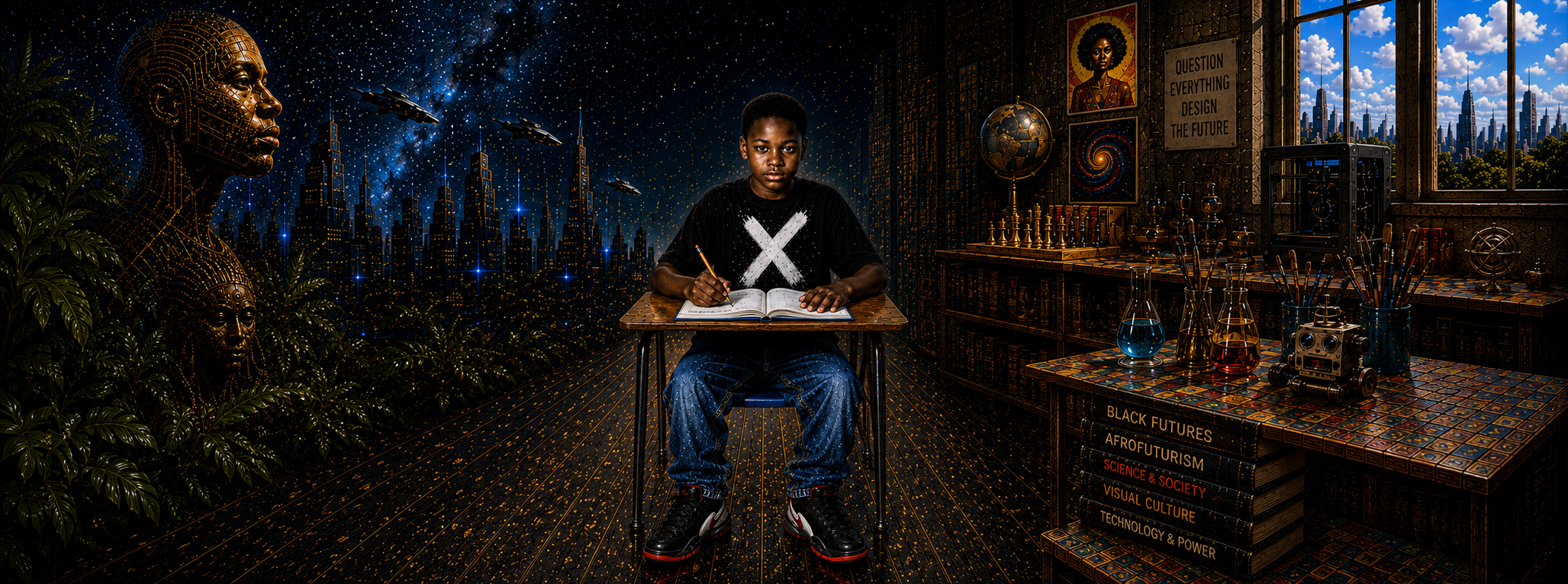
This essay examines the formation of Black intellectual identity across military mobility, racialized educational tracking, literacy culture, and institutional fragmentation in the United States during the 1990s and early 2000s. Through memoir, cultural critique, and educational analysis, this essay argues that Black intellectual life in America is too often produced accidentally, through isolated luck, personal obsession, and fragmented encounters, rather than infrastructurally through intentionally connected systems of cultivation, recognition, and support. Situating personal experience within broader debates around gifted education, literacy decline, Afrofuturism, and Black study, the essay proposes the need for intentional Black intellectual ecosystems capable of sustaining curiosity, rigor, futurity, and interdisciplinary formation.
I was a quiet child.
Quiet and sharp-minded. So quiet you could easily overlook me, and often you did, whether you meant to or not. But while you were not minding me, I was taking everything in—tracking the room, the rhythms of it, the hierarchies of it, the way attention moved and settled and withdrew. And whether you knew it or not, I was already advocating—silently—for something better than what was being offered to all of us.
And when an inquiry was tossed into the air, when something required not just response but thought, I came alive like a roar, full of confidence and intention; all in this small, skinny Black body.
These are the moments when you were guaranteed to notice me. Every single time.
This pattern did not begin as identity, however. Repetition was the real origin. I learned how to read rooms before I learned how to belong in them, and the difference between those two things—between perception and placement—would structure my entire educational experience. This was not because I was born with some mystical talent for perception. It was because I was a military kid, and movement made observation my own unique form of survival. By the time I graduated high school in 2002, I had passed through thirteen different schools across fourteen school transitions. I did not just attend school; I entered and exited systems. I learned their rules quickly at the risk of being swallowed by them. I learned which children mattered in a classroom, who had already been dismissed, which teachers were alive to the work, which teachers were only managing bodies, which students were there to learn, which were there to perform learning, and which had long ago discovered that little was expected of them and thus had adjusted accordingly.
Military children are often described in research as students of repeated transition. The Military Child Education Coalition notes that military-connected students are three times more likely to move than civilian peers. Researcher Sabrina Ruff and her colleagues similarly describe military children as navigating repeated relocations—often every one to four years—with each transition producing challenges around enrollment, adaptation, support, and belonging.
Every new school had a climate. Some were suburban and polished. Some were urban and under-resourced. Some were majority white. Some were mostly Black. Some were magnet schools. Some were vocational. Some had rigorous honors tracks; others had ceilings so low that I refused to learn while sitting on the floor . Unwittingly, I became a scholar of the natures of the American school system.
And in the rooms where the work was supposed to be taken seriously, I found myself regularly – and later expectedly – as the only Black kid in the class.
Not the only Black child in the school. Or in the neighborhood. And not even the only Black child with ability. But in these particular rooms—the gifted rooms, the honors rooms, the AP rooms, the accelerated rooms – I was often alone when it came to a specific intersection: I was Black, serious, intellectually hungry, ethically stubborn, and unwilling to treat school as a game of appearances. I later came to see just how frustrating my seriousness of school was: to my parents, my siblings and my socialization. And even I was able to see later that even despite my rigor and talent, my seriousness about school was also a distraction from personal fears.
There is a loneliness inside that kind of singularity that people too easily mistake for achievement. From the outside, I may have looked like a success story. I got the grades. I participated. I joined things. I ran for things. I started things. I found the advanced track and stayed with it. But success is not the same as being held. To be the only Black kid in the class was to exist in a strange double exposure. I was visible and invisible at once. Visible as exception. Invisible as experience.
Nobody in my life seemed to be tracking what it felt like.
My parents knew I was smart. My teachers generally knew I was capable. My friends knew I was “the smart one.” But knowing that I was smart was not the same as understanding the battle around my intelligence. It was not the same as asking what it meant for me to enter advanced classrooms where white students were treated as natural occupants and I was read as a variable. It was not the same as asking what it meant to leave those rooms and re-enter Black social spaces where my seriousness could become suspicious, useful, or socially awkward. It was not the same as asking what it does to a child to be repeatedly told, directly and indirectly: why do you care so much?
That question followed me for years, but it did not begin as a question.
It began as exposure.
1983–1994: The Forming of the Military Child
I was born in Fayetteville, North Carolina, on Fort Bragg Air Force Base, but the first house I remember as a real home was in a neighborhood called Spring Lake. It was not base housing. It was a lower-middle-class cul-de-sac near the military world but not fully of it. Behind our house were woods and sandy dunes, and that was where we (my older brother and I) spent most of our time—close enough to the house to remain under its invisible jurisdiction, far enough to feel as if imagination had room to test itself against the landscape.
Next door lived a white family with three boys. We played with them, but not without tension. Their household had a looseness and volatility that I associated, even then, with a different kind of class position. I did not yet have a sociological vocabulary, but I had eyes. I understood that proximity did not mean sameness. I understood that sharing a cul-de-sac did not mean sharing a world.
Inside our house, however, there was another kind of infrastructure. My parents were not pushing me to become a scholar. They were largely hands-off in the direct sense. They were not mapping a formal academic path or sitting me down with a theory of Black intellectual formation. But they created—or at least permitted—an environment where learning was always within reach. My father had three bookshelves filled with books: encyclopedias, children’s books accumulated over time, science-based books, political texts, and The Autobiography of Malcolm X, as told to Alex Haley. My father was a Black radical then. The letter X appeared throughout the house—on shirts, on hats, on objects that made the symbol feel less like decoration than declaration. My mother’s romance novels were there too, another archive altogether: desire, feeling, conflict, intimacy, interior life.
So before the internet, before knowledge became weightless and searchable, information had weight in our house. It occupied shelves. It had covers. It had volume. It could be pulled down, opened, entered.
School book fairs and Scholastic order days were part of the emotional architecture of elementary school in the 1990s. The thin paper catalogs arriving in class felt like events. You flipped through them at your desk circling possibilities, studying covers, imagining ownership before the books even existed in your hands. The book fair itself transformed parts of the school into temporary literary marketplaces: rolling shelves, colorful posters, stacks of paperbacks, novelty erasers and bookmarks, the feeling that reading was attached to excitement rather than obligation.
Somewhere inside those years, my father and I developed an unspoken system around those catalogs. I was the kind of child who reliably brought the forms home, carefully folded inside my backpack instead of crumpled at the bottom of it. I would pick some of the books I wanted, and he would quietly select others himself. There was no speech attached to this ritual, no grand educational philosophy announced aloud. But the pattern repeated often enough that it became part of the structure of my childhood. When the orders arrived at school and appeared on my desk in their thin cardboard packaging, I was usually one of the handful of students receiving books. The same thing happened when book fairs came through my schools. I learned quickly that if I asked my parents for money for books, there was a decent chance I would get it.
Even then, I understood something was being communicated through repetition. Books were not being treated as rare rewards or decorative objects. They were treated as expected companions to everyday life.
The Scholastic order forms belonged to a larger literacy culture that feels almost difficult to explain now: the classroom book club, the book fair, the paper flyer, the small economy of children circling titles they wanted and imagining the arrival of books before the books were in their hands. Scholastic traces its book-club model back to 1948, when students ordered affordable books through classroom forms; by the 1990s, that system had become part of the texture of school literacy for children like me. BOOK IT!, created by Pizza Hut in 1984, was another piece of that ecosystem: a national reading-incentive program for elementary students that rewarded reading goals with personal pan pizzas, reaching millions of children through schools.
I do not want to romanticize corporate literacy programs, but I do want to name what they did culturally. They made reading visible. They made reading social. They made books feel like objects worth anticipating.
Looking back now, what strikes me most is how palpable that literacy culture felt in the schools of my childhood. The energy around books was not subtle. Reading was marketed, ritualized, socialized, rewarded, and made visible. The paper catalogs. The classroom excitement. The book fairs. The read-a-thons. BOOK IT!. The teachers reading stories aloud dramatically to entire classrooms. The posters about reading competitions. The anticipation surrounding the arrival of books. Whether intentionally or not, schools in the 1990s often treated literacy as something alive.
And for me, it worked.
Even now, decades later, I can still remember the emotional feeling of those environments. The excitement attached to books was contagious. Reading did not feel isolated from culture or imagination. It felt connected to possibility, personality, discovery, humor, individuality, futurity. Books were presented not simply as academic tools, but as portals into larger lives.
And over time, certain authors and stories became permanent fixtures in my imagination. I still remember the feeling of discovering Patricia McKissack’s books as a child, the warmth and emotional texture of stories like Flossie and the Fox and Mirandy and Brother Wind. I remember Faith Ringgold. John Steptoe’s Mufaro’s Beautiful Daughters. Elizabeth Fitzgerald Howard’s Aunt Flossie’s Hats (and Crab Cakes Later). Those books carried Blackness differently than the world around me often did: with richness, folklore, tenderness, imagination, and interiority.
At the same time, my reading life was never culturally narrow. I loved Goodnight Moon. I loved the absurdity and chaos of the Wayside School books. I devoured R.L. Stine novels. Suspense, humor, fantasy, weirdness, emotional stories, folklore, horror, adventure. I was open to all of it. What mattered to me was the feeling of entering another world.
That mattered more than I understood at the time.
Because books were not just teaching me literacy. They were teaching me scale. They were expanding my emotional vocabulary, my imaginative vocabulary, my sense of possibility. Every author represented another mind I could travel through. Every story suggested that reality could be rearranged, reinterpreted, survived, escaped, redesigned.
Long before I encountered the formal language of futurism, speculative thought, or Afrofuturism, literature had already trained me to think beyond the immediate conditions of my life.
Part of what unsettles me now is that I rarely encounter that same collective literacy energy in younger generations at the scale I remember from childhood. The books still exist. Libraries still exist. Stories still exist. But something about the public culture surrounding reading feels diminished. I increasingly encounter young adults who appear deeply disconnected from language itself: uncertain in speech, uncomfortable with sustained reading, detached from articulation, expression, or verbal confidence. Not because they lack intelligence, but because they seem to have inherited weaker literacy ecosystems.
And that troubles me profoundly.
Because literacy is not merely about reading comprehension scores or academic performance. Literacy shapes imagination. Literacy shapes speech. Literacy shapes self-concept. Literacy expands a person’s sense of available futures. A child who reads widely is constantly rehearsing possibility.
Which raises a painful question for me: how did we allow one of the most important pillars of intellectual and imaginative life to weaken so dramatically? If literacy culture declines, futurity declines with it.
Especially for Black children.
Because throughout Black history, literacy has never merely been educational. It has been political, imaginative, spiritual, and liberatory. Reading has long functioned as one of the great technologies of Black survival and Black becoming. To weaken literacy culture is, in many ways, to weaken a community’s relationship to possibility itself.
And that is why I increasingly view literacy not simply as an educational issue, but as part of the infrastructure of Black futurism.
At the same time, even as a child, I noticed that not everyone around me experienced those moments the way I did. I was not the only kid excited about book fairs and Scholastic catalogs, but I was aware that for many students they barely registered as meaningful events. Some classmates hardly looked at the flyers. Some joked about reading entirely. Others seemed interested in the books but emotionally distant from the possibility of actually owning them. At the time, I could not fully understand why stories felt so alive to me and so unimportant to someone else.
It didn’t take long in my development before I began to understand that children’s relationships to reading are shaped by forces much larger than personal preference. Some families could not easily afford books. Some parents carried their own reading insecurities or educational wounds. Some children associated reading with embarrassment, difficulty, surveillance, or failure long before they encountered a story capable of moving them personally. Literacy scholars have long noted that reading confidence and reading identity are deeply connected to social environment, family literacy culture, representation, and classroom experience, particularly for Black children navigating systems where literacy has historically been tied to both exclusion and aspiration.
I also noticed something else in those classrooms. Sometimes read-alouds changed the atmosphere entirely. When teachers read stories aloud dramatically, or when classrooms rotated through passages together, or when students took turns reading scenes or chapters depending on the book, some of the tension around reading seemed to soften. Certain students who appeared disengaged during silent reading suddenly became animated, funny, emotionally invested, or attentive once storytelling became collective and audible instead of solitary and evaluative. Even as a child, I could sense that some students did not hate stories themselves. They hated what reading had come to mean about them.
Years later, I would come to understand how representation, access, literacy confidence, and family reading culture shape a child’s relationship to books. Valerie Wilson Wesley writes, “Black children need to see their lives reflected in the books they read. If they don’t, they won’t feel welcome in the world of literature.” That idea resonates deeply with what I was sensing as a child: that reading is not only a technical skill. It is also an emotional relationship to possibility, belonging, imagination, and self-recognition.
But even beyond representation, books themselves felt like portals to me. Every novel, every biography, every strange cover at a book fair suggested that reality was not fixed. The future could look different from the present. Life could expand beyond whatever room, city, family tension, or emotional climate I currently occupied. Long before I encountered the language of futurism or Afrofuturism, books had already trained my mind toward possibility. Even within instability, even within domestic turbulence, even while quietly grappling with parts of myself I did not yet know how to name, reading kept placing another idea in front of me again and again: the future did not have to remain identical to the present.
That is why, even now, when people say they “hate reading,” my instinctive response is that they probably just have not found the right book yet. Because for me, books never felt like punishment. They felt like expansion.
Research on home literacy has given language to what my childhood simply made ordinary. A 20-year study across 27 countries found that home library size has a substantial relationship to educational attainment, even after accounting for parents’ education, occupation, and other background factors. The paper’s abstract puts the matter plainly: children growing up in homes with many books get more schooling than children from bookless homes, independent of class and parental education. But research can only measure the structure. It cannot fully capture the feeling of a child finding books waiting for him on a school desk, or the slow formation of a mind that begins to believe information belongs within reach.
1989–1991: The Last of Innocence
By 1989, my family was living in Rantoul, Illinois, while stationed near Chanute Air Force Base, where I attended kindergarten and first grade. Rantoul felt starkly different from Spring Lake, North Carolina. It felt more wholesome, more family-oriented, more settled in its routines. Not wealthy, exactly, but middle-middle-class in the way it presented itself: clean streets, visible parents, a sense that family life had a public rhythm. It was the closest thing to Pleasantville I remember living inside, and at that age, the order of it felt like safety.
The school reflected that. I remember my first grade teacher, a nurturing newlywed white teacher Mrs. Bolt at Pleasant Acres Elementary School who had spent time in China and brought that experience into the classroom. She introduced us to Chinese culture, especially through the eyes of children, and we had pen pals. That idea—that there were children somewhere else in the world, and that a relationship could be formed through letters—expanded something in me. It made the world feel reachable. It made learning feel like travel without leaving the room. As a Black child in a Midwestern classroom, I was not just being taught facts; I was being invited into scale. That kind of exposure mattered. It made me wonder, later, how many other Black children were getting classrooms that opened the world that early, and how many were not.
1991–1992: An Unexpected Jewel in the Geechee South
After my family’s stint in Illinois, my parents made a drastic career decision. My siblings and I (now three of us) were to spend the upcoming school year in Fernandina Beach, FL – my mother’s birthplace – while my parents both accepted special duty orders to South Korea (to air force bases in Osan and Kunsan, respectively). Thus, second grade was a culturally rich one-off year in a historically-rich Black beach enclave, living with my maternal grandparents. More specifically, the neighborhood was the mystical American Beach. Island life. Geechee South. Atlantic Ocean. Bike rides to the beach. Seafood as regular breakfast food. Picking from the tall fruit trees in the backyard. Swinging from the makeshift chain and wood swing in the front yard. Fishing with my grandfather. Church on Sundays, with Sunday school first, then service, then Sunday dinner afterward. Bible study during the week when we could not get out of it. Relatives across the street, next door, down the road. First cousins arriving for weekends and school breaks for endless playtime. Great-aunts and great-uncles close enough that family did not feel like an event; it felt like geography.
I brought my reading skills and my books to my Grandma’s kitchen table in the add-on dining room my grandfather had built himself, expanding the house room by room as my mother’s family grew. And whenever my brothers, cousins and myself were doing too much ripping and running through the house in the summertime my Grandma would yell, “Ya need to get a book in ya hands ‘fore I put a stick on ya!” Let’s just say I was usually the one already prepared, a book somewhere nearby while everybody else eventually settled in front of the Nintendo.
It was also here that my early love as a casual music listener transformed into my love of musicianship. My youngest uncle — a high school scholar in his own right — was a multi-instrumentalist active member of multiple school band groups. His disciplined love of composition, conducting and rigorous devotion to daily instrumental practice inspired me to explore my own musical gifts once I was back with my parents. Later, I became proficient in the B-flat clarinet, bass clarinet, alto and tenor saxophones and performed in four school bands including two marching bands — all because of my uncle’s example.
That year in the Geechee South felt singular—slower, warmer, culturally rooted in a way the military base environments were not. The place did not feel assigned to me. It felt inherited, even if I was only borrowing it for a year.
American Beach itself carries a history that deepens that feeling. Founded in the 1930s by Abraham Lincoln Lewis and the Afro-American Life Insurance Company, it became one of the few Florida beach communities where Black people could gather during segregation, a place for Black leisure, family, and dignity in a society that denied Black people ordinary access to the shore. The phrase attached to its history—“recreation and relaxation without humiliation”—names exactly what made the place more than a beach. It was infrastructure for Black life.
Even school there carried inheritance. My second-grade teacher – one of my most indelible, Mrs. Willie Ina Harper – had also been my mother’s second-grade teacher. Also an elder white woman (with thick half frame spectacles and wiry hair) her love for my mother as a schoolgirl in the 1960s was the center of our relationship. She often shared her deep affection of my mother with me and on special trips home from Korea, I loved see my mother and Mrs. Harper interact. It was like watching time come alive again. And I came to treasure her immensely. That kind of continuity does something to a child. It tells you, without saying it outright, that you are not appearing from nowhere. Someone before you sat in that room. Someone before you learned under that voice. The past had not vanished. It was waiting, still warm. These experiences for me made up the fabric of that magical year in American Beach.
1992–1994: The Unknown and Unexpected West
After that year, my family accepted orders to Nellis Air Force Base in Las Vegas, Nevada. The move itself took three days by car from Florida to the desert Southwest, and somewhere during that long ride, my parents changed the emotional climate of my childhood forever.
I can still see the moment clearly. Me and my brothers were sitting in the backseat while my father drove and my mother sat in the passenger seat. At some point during the drive, they turned and told us they were getting a divorce.
And that was it.
No long explanation. No roadmap for what this would mean once we reached Nevada. No real discussion about what would happen to us, to them, to our family structure, or to the life waiting ahead. Just the announcement sitting in the car with us for the remainder of the trip.
I do not think I fully understood divorce yet as an institution. But I understood rupture. I understood that something foundational had cracked open. Looking back now, that drive feels like one of the great dividing lines of my childhood. I remember sensing, even then, that some earlier innocence had ended permanently. Nothing was ever going to feel entirely safe or predictable again in the same way.
And then eventually came Las Vegas.
I will never forget approaching the city from the east for the first time and watching the highway slowly unveil the lights ahead of us. The city seemed to rise out of the desert floor itself, neon and electricity emerging from darkness little by little until the horizon became fully alive. I had never seen anything like it before. The sight filled me with excitement, but also something else: fear of the unknown. Those lights felt attached to a future I could not yet understand. We were in the desert now. My parents were separating. Everything familiar felt far behind us. Even as a child, I sensed that this new life was going to expose me to realities I had never encountered before, and that I would have to adjust to them quickly.
The whimsy of beach life was over. Humidity gave way to dry, stoic heat. Desert life replaced island life, and the shift was not gentle, by no means..
Las Vegas in 1993 felt transient and expanding, a city of appetite pressing against the edges of a military system built on discipline. During third and fourth grade, we lived in base housing, and military life carried its own atmosphere and culture. Planes flew overhead so constantly that their roar became part of the weather. If you were on the main base at four o’clock, you stopped and froze while the national anthem played. You stayed on sidewalks. You wore a helmet riding your bike. You knew not to wild out because your behavior did not stop with you. It traveled upward to your parents. There were air shows, structured youth sports leagues, rules, routines, consequences. Everything had a lane. Everything had a system.
And then, right outside the gates, there was Las Vegas: casinos, strip malls, convenience stores, gambling folded into everyday life, neon sitting across from the controlled geometry of the base. Inside the walls, order. Outside the walls, appetite. I was living inside one world while looking at another just beyond it, and that contrast trained my eye.
And yet, socially, those years were flourishing for me. Military childhood carried a strange multicultural normalcy. Las Vegas had a particularly large Filipino population at the time, so many of my closest friends were Filipino, alongside Black kids, white kids, Latino kids, and the constantly shifting mix of military dependents arriving from everywhere: Germany, Guam, Korea, England, bases I had never heard of before. It was normal to meet a kid who had just moved from another continent. Normal to hear adults casually discussing deployments, transfers, and temporary separations as part of ordinary life.
My older brother and I spent enormous amounts of time moving through the ecosystem of base childhood: youth-center activities, basketball leagues, baseball, bike riding, parks, basketball courts, neighborhood games, sleepovers, garage hangouts, wandering the maze of base housing with friends until the streetlights came on. Every other Friday, the youth center held dances split between younger kids and teenagers, and those nights became miniature rehearsals for adolescence itself: first girlfriends and boyfriends, hand-holding, first and second kisses, awkward slow dances, breakups, jealousy, rumors, notes being passed around school every thirty seconds. Childhood social life becoming something more emotionally charged.
Sanrio culture was huge among kids in Vegas then, especially among my Filipino friends, and I got deeply into it. Everybody had favorite characters. Mine were Keroppi and Ahiru no Pekkle. We collected wallets, notebooks, keychains, little accessories from the Sanrio store at the mall and treated those choices almost like extensions of personality. In the 1990s, Sanrio had become a major youth phenomenon across many suburban and military communities, especially on the West Coast, where Asian-American culture, mall culture, skate culture, and alternative youth aesthetics often blended together in everyday life. Those stores felt less like ordinary retail spaces than tiny identity boutiques for children and teenagers trying to assemble themselves through taste. Choosing a character was never just about merchandise. It became part of how you signaled humor, softness, coolness, weirdness, belonging. Even then, I was learning that culture lived in objects, symbols, and aesthetic codes long before I had academic language for any of it.
At the same time, I was becoming obsessed with magazines, music, and style. My friends got me right styling me in oversized shirts, sometimes taken straight from my father’s closet, oversized jeans stapled tight at the bottom, button wallets, Jansport backpacks wore hella low and Adidas classics tennis shoes were mandatory to complete the look especially to be apart of the unexpected cultural trend I became immersed in next..
One of the biggest worlds that opened to me was breakdancing culture. In Vegas at that time, many of the Filipino kids seemed to dominate that scene, and Black kids like me flowed into it alongside them. Me and my brother became immersed in it. Kids battled on flattened cardboard laid across garage floors or really any surface where a battle wanted to pop off. Everybody practiced moves obsessively. My signature move became the Russian kick. Looking back now, I realize how much of that culture was about rhythm, confidence, physical improvisation, performance, and belonging.
And all of this social richness existed alongside a growing turbulence inside my home that I had never seen before.
Because while my outer world was expanding, my inner world was becoming increasingly unstable, scary and claustrophobic. The divorce my parents had announced in the car never seemed to actually arrive. Instead, we all remained together inside a household growing more volatile with time. Arguments. Fear. Tension. Sometimes violence. The temperature in the house whenever both my parents were home was always tense and palpable. And altercations could appear seemingly out of thin air.. Me and my brothers heard things, witnessed things, absorbed things we did not yet know would take decades to process.
But we also did not really know how to lean on one another emotionally. My younger brother was much younger than me. My older brother and I, despite sharing activities and environments, often moved through life like oil and water. We played on the same sports teams sometimes. Shared neighborhoods. Shared rules. Shared parents. But internally we remained very separate people with separate emotional lives.
My parents did maintain one absolute rule: we were never allowed to say we did not know where one of our brothers was. If one of us disappeared, all of us were accountable. That rule stayed with me. Even now, I can still feel the psychological structure of it.
So underneath all the friendships, basketball games, dances, magazines, breakdancing, and bike rides, my nervous system was quietly being rewired by instability I did not yet have language for. I understood early that what happened inside our house was not something to discuss publicly. I learned silence. Observation. Adaptation. I learned how to keep functioning while emotionally overextended. But deep down, I also knew that my friends and peers were dealing with their own levels out hardships at home as well.
The military projected order publicly: pressed uniforms, ceremonies, discipline, hierarchy. But many military children quietly understood that turbulence inside households was common. We heard arguments through walls. We watched marriages strain under pressure. We normalized instability because instability was normalized around us. Years later, I came across a Department of Defense report describing military family separation as producing “emotional uncertainty and ambiguity in the family,” including situations where “a family member may be physically present but psychologically absent.” I remember reading that and thinking: yes. That was the atmosphere.
It was at Lomie G. Heard Elementary, on base, that I was selected, tested, and entered into a GATE program—Gifted and Talented Education. GATE programs identified students through a combination of teacher referral, academic performance, standardized measures, and cognitive assessment. These programs were designed to cultivate advanced intellectual potential, but their access patterns were never neutral. In federal civil-rights data, Black and Latino students have been repeatedly underrepresented in gifted education; one widely cited U.S. Department of Education figure found Black and Latino students were 42 percent of students in schools offering gifted programs but only 28 percent of gifted enrollment.
At that age, I did not have the vocabulary to describe what was happening. I did not think of myself as gifted, nor did I understand the institutional processes that determined who entered those programs. What I understood was movement. The mind was allowed to move, and in some cases, it was expected to.
We did more than worksheets. We experimented. We built things. We made life-size mummies (by wrapping your peers in masking tape), plaster masks, painted objects, models of thought that lived in the hand as much as in the head. I loved those projects so much that I recreated versions of them at home. GATE opened my artistic side, my science side, my appetite for making. Chemistry sets followed. Model trains. Drum sets. I did not leave the classroom at school; I dragged the classroom into the rest of my life and kept building from it.
I did not know any of the politics of gifted access then. What I knew was feeling. In those gifted rooms, learning moved. It had velocity. It required attention. It was not only about completing worksheets or behaving properly. It had pattern, anticipation, pressure, play. Academic bowl entered my life there, not merely as competition but as a form of mental choreography. You had to know, connect, recall, leap, risk. The mind was not being asked to sit still. It was being asked to run.
Those years did not make me a scholar. They gave me a memory of what intellectual aliveness felt like.
When I found myself in environments that did not offer that aliveness, I could feel the absence even if I could not yet name it. A child who has tasted rigor recognizes when he is being fed maintenance.
1994–1996: Out-of-Body in ATL
After these early years came a confusing displacement. Before the end of the school year, it was announced that we would not be returning the following school year. My father had accepted a rare opportunity for early retirement from the military after fifteen years of service. With that decision came another: my brothers and I were leaving with him from Las Vegas to Atlanta and leaving my mother behind in a family drama I did not fully understand at the time. I only knew that something had gone wrong in the adult world and I had been relocated into the consequences. (I came to find out 30 years later that this was a blackmail move by my father to my mother.)
For a brief period, we lived with the Michaelsons, family friends in Ellenwood, Georgia, while my father tried to stabilize the next transition. I attended an upper-middle-class elementary school whose name I still cannot remember. I was there only briefly, maybe a month or two, but I remember fitting into the classroom with surprising speed – almost as if a presence like mine had been longed for. I was one of only a few Black children in a heavily white environment, and for reasons I still cannot fully explain, I became unusually bold there. This was one of those instances where I remember being conscious of white children’s curiosity and almost thirst to experience an “urban” Black child up close and personal. And I could definitely play that part. But usually the duality of that perceived perception and my level of intellect confused the white child who was looking forward to what Black folks call “niggatry”. Not cruel. Not disruptive in some dramatic sense. But amused by certain classroom systems that already struck me as artificial or anti-intellectual. I remember classmates laughing when I challenged little rules or routines that felt pointless to me. Maybe part of me already knew the arrangement was temporary. Maybe I sensed I would disappear from that environment before consequences could settle around me.
Then came Decatur.
For the bulk of fifth grade, I attended Snapfinger Elementary while my father rented us an apartment near Glenwood Parkway. This was not military-base order or inherited Black coastal community life. This was the mean streets of Decatur in the early 1990s, with all the density, tension, improvisation, and volatility that phrase carried back then. Even before arriving there, I already understood something about violence and neighborhood territoriality from our years in Las Vegas. At Nellis Air Force Base and in surrounding neighborhoods, Black and Mexican gang tensions often bled into school life and childhood geography. School shootings were common in urban cities. Even military structure could not fully insulate children from the atmosphere surrounding them. You learned quickly which colors meant something, which neighborhoods carried tension, which older kids were dangerous, which routes home required awareness.
So Decatur did not feel foreign to me exactly. But it felt intensified.
My father seemed to believe this environment would “firm us up,” especially his sons, toughen us against softness he associated with military upbringing. He wanted us outside. Social. Moving through the neighborhood. Learning how to navigate the streets. But my reaction to the environment was almost the opposite. I became what my father bitterly called a “hermit,” something he often assaulted me with that might as well have been a curse word (my father had a talent for making even everyday words sound like poison on his lips). He could not understand why I had no desire to roam this neighborhood. In my head, my answer to him was “Nah, I’m good on this.” I remember I kept trying to understand why did I need to get comfortable with a world that I knew for sure was never going to be my chosen world or way of life. My life had intersected with street life many times up until this point, so I was not naïve — though I think my father believed since I hadn’t gone up against the roughest of street situations, I still had no idea. I never agreed with that. Still, I did have to go outside once and a while and fake busy sometimes to appease him.
What he misunderstood about me at this age and in this environment was that I was not antisocial because I was naïve or socially inexperienced. By then, I had already been deeply socialized into childhood life. I had slow danced at school functions. Held hands with girls. Been in neighborhood fights during our years in base housing. By fourth grade, I had already had my first real girlfriend and my first French kiss behind a tree in my backyard. There had already been smaller childhood sexual curiosities and explorations among friends long before the mean streets of Decatur entered my life.
I had even already been punched in the face once back in fourth grade by a boy, Roderick, who I had quietly started bullying because I felt threatened by how close he was becoming to my third and fourth grade best friend, Quentin. At the time, my best friend and I existed in my mind as a unit: number one and number two, inseparable. We were even the fastest in our grade. Then this other boy entered the picture. He was fast too. Faster than me, actually, which bothered me almost as much as the friendship itself.. I had now been pushed to number three.
One afternoon after school in the neighborhood, while I was on rollerblades, he punched me hard in the jaw and took off running. I’ll never forget the instant tears that came to my eyes from the sting to my jaw. What stayed with me afterward was not even the punch itself as much as the humiliation of not being able to catch him. He outran me that day into his backyard, and after that he mostly avoided me altogether for the rest of the year. Years later, in eighth grade and my return to Las Vegas, we became the best of friends.
Childhood social life is strange like that. Competition, jealousy, admiration, embarrassment, loyalty, violence, and friendship often exist tangled together long before children have the emotional language to separate them cleanly.
So, in other words, I was not sheltered from social life, attraction, embarrassment, conflict, performance, or risk. I was already learning the strange choreography of children becoming people.
But my father knew almost none of this because emotional transparency was not the architecture of our family. Those experiences belonged to my private interior world. They were my secrets.
What he interpreted as weakness or withdrawal was often discernment. I did not crave socialization for its own sake. I craved stimulation, imagination, emotional charge, intellectual discovery, the feeling that something alive was happening. If an environment felt spiritually empty to me, I withdrew from it quickly, even while continuing to study it carefully from the edges.
And Decatur taught me a great deal from those edges. Things I could never forget.
I remember one afternoon in particular: two Black girls from my school got into a fight while a slew of us kids were walking home, one punch landing hard enough to burst the other girl’s nose open, blood pouring down her face while she cried the entire way down the sidewalk. Nobody around me reacted as though the moment were extraordinary. It belonged to the environment. Violence had already been normalized into the atmosphere.
My other memories of that year in Decatur return to me less through plot than geography: the long road to and from school, the daycare next door where we picked up my little brother after school, walking the overpass to the flea market, the smell of the school hallways, the constant checking through apartment windows to see whether my father’s car had returned yet, and the sudden scramble to jump into bed once we realized he was home and we were still awake past our strict bedtime.
At Snapfinger, I had a genuinely good teacher, Ms. Eisenberg. I still remember her short gray haircut and her flowing wardrobe. She was firm but caring, the kind of teacher who understood that structure and warmth did not have to oppose one another. Throughout my education, I repeatedly encountered teachers who cared deeply, who recognized seriousness in children, and who tried to cultivate it responsibly. Even after moving across thirteen schools, and especially now looking back as an adult, I realize how fortunate I often was in that regard.
But a good teacher cannot always overcome the architecture of a room.
At Snapfinger, I remember feeling a ceiling. I could still succeed academically. I remained one of the smart kids. I joined spelling bees, recorder club, choir, whatever outlets remained available. But intellectually and emotionally, I felt compressed. There were fewer spaces where my mind felt invited to stretch toward complexity or possibility. Living separated from my mother, socially peripheral at school, increasingly internalized inside myself, I felt tucked into a corner of my own life.
The only friend I clearly remember from that period was Shamika. Other children had already designated her strange, ugly, undesirable, socially disposable. And I did, too, initially. She was definitely strange. And loved to insult people, which is mostly why kids deemed her unlikable. But I found something underneath her brashness: humor, surprising sensitivity and intellect. And I recognized something familiar in her isolation. We became friends. And because I stood beside her, some portion of the contempt directed at her eventually drifted toward me too. But Shamika could give as good as she got. She had mastered the art of self-survival in exile. And she was definitely no punk. And as for me, I think somehow it always got across that trying to force me into the weak, smart kid stereotype would never work on me. Something in the way I handled classmates and myself, always protected me from would-be bullies. I think everybody was clear that I wasn’t above fighting if it came to that.
Ms. Eisenberg’s classroom at Snapfinger taught me another lesson early: belonging is never neutral. It is enforced.
In the summer after 5th grade ended, a fire erupted in the apartment building where we lived, and after some instability my Dad pulled the plug on Decatur and uprooted us to his hometown of Pittsburgh, Pennsylvania. These trips were getting me very familiar with cross-country travel by car which I mirrored years later in my dozens of cross country treks as an adult.
1996: Danger in the Front Yard: A Brief Stint in Pittsburgh
I remembered my grandmother’s house on Sheffield Street in Pittsburgh’s North Side during the mid-1990s gang wars between groups like the Manchester OGs and the Hoodtown Mafia that rippled through the surrounding Manchester corridors. Drive-bys and retaliatory shootings had become normalized enough that neighborhood fear itself felt infrastructural. Adults talked about violence the way other places talked about weather.
And yet my memories of that period are not dominated by fear alone. I remember walks to corner stores for sunflower seeds, playing tops and dice, chalk-outlined hopscotch, learning double-dutch, video games, freeze cups, soda pops, and candy from the candy lady. I remember church dinners, bus rides downtown with my Granny, reefer smells drifting through the neighborhood air, my Uncle Antoine’s masculine affection, my older cousin Shauna’s fly outfits and hairstyles, my little cousin Boo Boo’s room overflowing with toys, my Aunt Tracey and Aunt LaVetta’s maternal protectiveness, the crowded household, matching windbreaker outfits, doing the “running man” at family parties, and trying to keep track of the names of endless cousins around my age, all wrapped inside that charming, unmistakable Pittsburgh twang. I remembered an overall family loyalty I had never encountered before, a feeling that family there was not an event but an ecosystem.
But I could not remember school clearly. I remembered Allegheny Middle School more as a weight than a narrative. A building. A locker. The fact of going. And I remembered a neighborhood boy in my class named Paris whose bottom lip stuck out like the smart-mouthed baby Pee Wee in the movie Bebe’s Kids.
Paris was a little thuggish kid, street-touched even then, but sweet to me. Cute. Memorable. A boy I bonded with on walks to and from school. He reminded me of a child-sized Tupac in spirit, though I have no idea whether he possessed any artistic talent himself. I only remember sensing something deeply alive in him and, at the same time, something endangered. Even as a child, I could feel the direction certain environments pulled young boys toward. To this day, I have often wondered what became of him. Sometimes I have imagined that he may not have lived a long life, not because I want that to be true, but because the atmosphere surrounding boys like him already carried a kind of premature mourning.
And even with all of his turbulence toward the world, what I remember most clearly was the calm he had with me. I would later encounter that same calm in many more Paris-types who moved through my life over the years. It has always made me feel deeply bonded to my Black brothers who struggle to find that kind of ease, safety, or recognition in other spaces of their lives.
1996–1998: Re-entry to Vegas and the Unfamiliar Familiar
My Dad always says he brought us back to Vegas because we missed our Mom too much during the almost two years we had struggled on the East Coast. I always saw this explanation as a gross oversimplification of the truth. Whatever the reason, I was glad to return to some version of familiarity. Or at least what I imagined familiarity to be.
I was now transferring in as a continuing sixth grader at Swainston Middle School and, at this time, something reopened.
Swainston was suburban. It had a different atmosphere, a different academic texture. The teachers were strong. The classes were tight. There were activities to enter, structures to use, extracurricular channels sturdy enough for a student to build around. It was also my first experience attending a year-round school operating on a track system divided into three trimesters, a model that had become common in rapidly growing Las Vegas during the 1990s as the city struggled to absorb exploding population growth. School in the summertime still felt surreal to me then, as though the normal calendar of childhood had been rearranged.
And unexpectedly, so was Vanessa, my first real girlfriend from fourth grade in Las Vegas, a beautiful Filipina girl I had not seen since my family first left Nevada. Back then our relationship had lasted only a couple of weeks, but childhood relationships carry a disproportionate emotional gravity. The problem was that she refused to speak to me when we passed each other in the hallways. I eventually learned why: she believed that after our breakup I had called her a “ho.” Knowing myself at that age, I probably did. Part of the emotional chaos surrounding it was that she had briefly left one of my close friends for me, temporarily straining our friendship before he and I eventually repaired things. Even so, seeing someone from my first Las Vegas life suddenly reappear inside this new version of it felt strangely cinematic, like one timeline colliding with another.
Socially, I had friends. A mixed group: Black kids, white kids, Hispanic kids. My closest friends during that stretch were a white boy named Brett and a Mexican friend named Jose. Brett’s family was newly fractured by divorce, and I spent a great deal of time at his mom and dad’s two separate houses that I would visit with him, sleeping over his house on weekends and sometimes school nights, watching how another family navigated instability differently from my own. At the same time, I also had neighborhood friends from our apartment complexes, church friends, sports teammates, and Air Force-family friends spread across different parts of Vegas. At nearly every turn, I was moving through a different world.
And those worlds did not resemble each other.
What stands out to me now is how many different cultural systems were shaping me simultaneously during those years. In one part of my day I might be in honors-track classrooms or extracurricular activities. Later I might be wandering suburban malls with friends, shopping at Spencer’s, wearing chain wallets, oversized shirts, and wide-leg jeans dragging and fraying at the bottoms. Alternative culture and stoner culture were huge at Swainston then. Alanis Morissette’s Jagged Little Pill and No Doubt’s Tragic Kingdom became formative albums for me, expanding my tastes beyond the hip-hop, R&B, soul, and oldies I had already absorbed through my parents and older brother. At the same time, Aaliyah’s One in a Million and Tupac’s All Eyez on Me were equally massive presences in the social atmosphere around us. What fascinated me was watching all those worlds collide inside the same hallways. White kids obsessed with Tupac. Black skater kids immersed in alternative culture. Black stoner kids who moved almost entirely inside white suburban aesthetics. Mexican kids floating between all of it.
I saw very clearly, even then, the assimilative pull of certain environments. Not necessarily in a wholly negative sense, but I recognized it. Some Black students became fully absorbed into suburban alternative culture in ways that seemed to flatten or distance parts of themselves. Watching that happen made me consciously decide that I wanted balance. I wanted to expand without disappearing. I wanted to absorb new influences without losing the deeper cultural grounding that already existed in me.
And adolescence had absolutely arrived by then.
Drugs, sex, gangs, emotional instability, teen pregnancy, depression, suicide, fights, expulsions, police trouble: none of these things felt distant from us. They were already embedded directly into youth culture around us. Swainston simply intensified their visibility. These realities were not happening at the edges of teenage life. They were in the rooms with us. Some students were already experimenting heavily with drugs. Some students were sexually active (I was definitely one of them). Some students were dealing with pregnancies. Some students were spiraling emotionally in ways none of us yet had language for. During those years we experienced suicides connected to the school community. Gang culture still hovered around Las Vegas youth life heavily enough that nearly everybody knew someone adjacent to it. Fights, arrests, rumors, emotional collapse, performative toughness, and premature adulthood all circulated through the hallways as part of the normal social atmosphere.
But I never felt overwhelmed by it in the way adults might assume. By then, I already understood turbulence as part of the emotional architecture of life. I was participating in adolescence fully while also studying it constantly. Some part of me was always simultaneously inside the room and analyzing it.
Outside school, life was equally full. My parents had reunited under the same roof again, which meant the turbulence of their relationship had also returned to the center of family life. The volatility between them remained emotionally unpredictable and, at times, frightening. At the same time, my mother had begun pulling us more deeply into church life. We attended regularly, joined choir, participated in church activities, and became increasingly embedded in that social structure. Meanwhile my father insisted that me and my brothers learn practical competencies he viewed as essential. During those years he made sure we learned how to swim at the apartment-complex pools where we lived. He kept us in basketball, baseball, bowling leagues, and structured youth activities. He was pursuing his own master’s degree at UNLV while also trying, in his own complicated way, to prepare his sons for the world.
It would be inaccurate to say I lived only in solitude. That is not the truth. There were entire stretches of my childhood and adolescence where my social life was full and alive in the ways that matter when you are young: movies, malls, sleepovers, long bike rides across the city, bowling leagues, basketball games, church rehearsals, and endless hours wandering through suburban Vegas with friends before being picked up later that night. I knew how to belong. I knew how to socialize. I knew how to move between worlds comfortably.
But even in those environments, something in me remained slightly offset. Not disconnected. Not superior. Just tuned differently. I was participating fully, and at the same time some part of me was always studying the room.
Back in the classroom, that observation slowly became a leadership instinct before I had language for leadership itself. I paid attention to who needed encouragement, who needed to be challenged, who had something to offer but had not yet been given permission by the room, or by themselves, to offer it. I noticed who needed a chance to shine, who needed to show off, who needed re-empowerment. When I got opportunities to lead, formally or informally, I tried to lead with that awareness in mind, especially with my Black peers. I did not lead by dominating space. I led by redistributing it. Making sure people were seen. Making sure people were activated rather than overlooked.
In seventh grade, I earned straight A’s for the entire year and received a plaque or trophy that I loved. I wish I still had it. But the object matters less than the consciousness forming around it. Seventh grade was when I began understanding deliberately that I was not merely a child who happened to do well in school. I was choosing a direction. From that point forward, I permanently placed myself on the honors track. If the highest academic version of a class existed, I entered it.
I was not passively “placed” into rigor. I learned to place myself there.
At Swainston, I also did one of the things I remain most proud of: I started an academic bowl club. That impulse began during the gifted years as exposure, but by middle school it had become something I wanted to recreate socially for myself and others. The school either did not have such a club or had not sustained one for some time. I learned the process. I found out we needed a sponsor. I found a teacher. I recruited friends. We formed the club. We practiced. We traveled to competitions.
That mattered because it was not simply about joining an intellectual space. It was about building one.
Even then, I wanted learning to feel social, contagious, alive. I wanted my friends to understand that academics could be exciting, communal, competitive, emotionally rewarding. I had not yet developed the language of Black intellectual infrastructure, but the impulse was already there: if the room does not exist, build it.
Outside school, my intellectual life was also becoming increasingly self-directed. During sixth, seventh, eighth, and ninth grade, I began taking solo all-day bike journeys to libraries across Las Vegas, including the public library in North Las Vegas and the main library on base. I made entire days of it. I would ride across the city, spend hours reading, researching, checking books in and out, sitting in parks, stopping for food, then eventually riding home before dark. Nobody assigned this to me. Nobody graded it. Nobody tracked it.
But that was also school.
That was also formation.
I was not simply a student inside classrooms. I was already becoming a young Black intellectual building a world of inquiry around himself when the official rooms were not enough.
The next year brought another major transition. After my mother was approved again for base housing, now that our entire family was back together and needed more space than our cramped two-bedroom apartments could offer, we moved back onto Nellis Air Force Base full-time. Surreally, we ended up directly across the street from the very house we had lived in before leaving Vegas years earlier. Returning to the same block felt almost like stepping back into a former life.
But the neighborhood was no longer the same. Most of the friends we had grown up with there were gone, transferred with their military families to other bases across the country or left behind entirely after retirements and relocations. So despite returning to familiar ground, I still had to begin socially all over again. That part felt daunting at first, especially because I still wanted to remain connected to my friends from Swainston and the suburban world I had grown attached to.
What intensified that anxiety was knowing where I was about to go to school. Jim Bridger Middle School already carried a reputation long before I ever entered the building. It was the same school my older brother had attended years earlier while I was still in fourth grade, and I remembered the tension surrounding it vividly. I remembered conversations about gangs, school colors, neighborhood affiliations, and the complicated calculations around what was supposedly “safe” to wear. I remembered my parents trying to help him navigate those fears and social politics at an age when children should not yet have had to think so carefully about survival. So when it became my turn to attend Bridger, I tried everything I could think of to avoid going there. I did not want to leave Swainston. I did not want to leave my friends. And I did not want to enter a school whose reputation had already been introduced to me through fear.
But all of that resistance came to no avail. For eighth grade, I officially transferred to Jim Bridger Middle School, an inner-city school in Las Vegas, and the shift was immediate. Swainston had been suburban, shaped heavily by skater culture, alternative culture, and the sprawling mall-oriented atmosphere of mid-to-late-1990s suburban youth life. Bridger was more heavily Black, more urban, and the divide between honors and general education felt much sharper. At Swainston, even the general-level classes usually maintained some baseline of structure. At Bridger, the separation between academic tracks felt far more dramatic. The honors classes could still be strong, with strong teachers and serious students, but many of the general classes felt like entirely different worlds operating inside the same building.
This was where the problem of tracking became visible to me before I knew the scholarship around it. Jeannie Oakes’s landmark work on tracking argues that grouping students by perceived ability “reflects the class and racial inequalities of American society and helps to perpetuate them,” with clear differences across tracks in content, instruction, teacher-student relationships, expectations, and classroom climate. I was living the interior of that claim. I could feel how different rooms in the same school produced different kinds of students because they demanded different kinds of behavior from them.
At Jim Bridger, I had Algebra I Honors with a tall woman teacher with thick glasses, wild, brash energy, humor, and real toughness. I struggled. I did not pick up algebra easily at first. I got my very first bad grade on a report card that I remember shedding tears over. It devastated me. I then made the decision – after discussing with my Mom – that I would make attending the help sessions which my Algebra teacher held after school would be how I would spend the majority of the year. My grades were more than worth the sacrifice to my social time. I attended those help sessions several times a week (along with several of my friends from that class who also were struggling) and then caught the late bus home. During my 8th grade year, it was normal for me to make it home daily around 5 and 6pm due to various after school activities and tutoring. By the end of the year I managed to leave Algebra I Honors with a C average that I was proud of because I worked hard at a subject that I initially found unexpectedly difficult. (Years later taking Algebra II Honors, I returned to my formal glory of high grades having no problems grasping the math by that point). It matured and humbled me that as I was continuing my academic journey the realization I was not going to ace every subject as easily as I had always had. That I was not naturally dominant in every subject like I possibly assumed unknowingly due to my previous ease. Math could humble me. AP Physics later would humble me as well as AP Macroeconomics senior year. But difficulty never made me want to cheat. It made me want to understand.
In that algebra class, cheating happened. Not only among Black kids, but among different students in that mixed honors environment. Sometimes it was subtle; sometimes not subtle enough. I remember feeling that the teacher knew but did not always intervene. Almost as if she expected it and as long as wasn’t brazen she wasn’t stepping in. I found this odd. I mean this was an Honors class, right? And we were a mostly Black and Hispanic school but our Honors classes skewed half White and the other half Black and Hispanic. But the White kids were cheating, too, so I chalked all of it up to the teacher. Maybe she had just grown tired of teaching students. I also remember feeling like her teaching style wasn’t resonating with us. I felt she moved too fast for the class. Which may explain my most of the class was always attending those after school help sessions. I remember watching students try to move around the difficulty of the class rather than enter it.
And I remember kids asking me why I would not do the same.
That question came in many versions across my K–12 life, mostly from Black peers in Blacker or more urban environments. Why don’t you cheat? Why don’t you copy? Why do you always do your homework? Why do you care? Why are you trying to be smart? Sometimes it was playful, sometimes mocking, sometimes bewildered. A shit-talking Black classmate named Jamie Bell in my 6th period Geography class, who tried to bully me at first before we became cool, was part of that ecology. Even making me ask myself at times, Am I gonna have to fight this nigga at some point? He picked at me. Asked me if I was gay. Where did I get my Jordans? What hoes was I fucking? He tried to pull me under, or at least test whether I could be pulled. I could not. By then I was solid enough in my academic direction that underachievement did not tempt me. I was amused that he found me, a Black young man who he knew lived on the military base and not in the surrounding lower-income neighborhoods, a paradox. I mean, outwardly, I looked like any of them. In the hallways I mixed well socially within our urban (some would say ghetto) school environment. Yet in class, I was deeply academic. I could see it in his eyes: But what are you, really? But his questions, and the questions of others, stayed with me because they were not really asking about homework. They were asking about allegiance.
Why are you aligned with this?
Why are you not resisting school the way we resist school?
Why are you not treating this whole thing as something to get over on?
There is a dangerous way to write this, and I do not want to write it that way. I am not saying Black children do not value learning. I am saying that in many of the Black peer environments I moved through, I encountered a tension between Black social belonging and overt academic seriousness. That tension has been debated in education research, sometimes carelessly under the label “acting white,” a phrase that can become reductive if used to blame Black students rather than examine the conditions shaping peer norms. My experience lived inside that complexity. I knew Black kids with ability who did not want the burden of the harder track. I knew Black kids who were smart enough for honors but chose easier classes. I knew Black kids who respected my intelligence but saw it as useful before they saw it as communal. I knew Black kids who were learning social fluencies I lacked and perhaps needed, while I was learning intellectual disciplines they did not value in the same way. And I knew that my frustration with them was braided with grief. I wanted more of us in those rooms.
I did not want to escape Black people. I wanted to find Black intellectual company.
At Jim Bridger, two teachers became deeply important to me: Mrs. Gray and Mrs. Lillian Rhodes. Mrs. Gray taught my Geography class. She was a Black woman in maybe her late thirties or forties, serious, sharp, disciplined, but very warm with me in a way I still remember clearly. I think she recognized quickly that I was smart, respectful, and trying hard to carry myself seriously inside an environment where a lot of kids were navigating pressure in different forms. She expected excellence from me in a very direct way.
That same year, my father had started substitute teaching while working on his master’s degree. Once Jim Bridger realized he had a student there, they started calling him in often. So there were days where my father was literally my substitute teacher in eighth grade. Sometimes in Mrs. Gray’s Geography class itself. All the kids thought it was cool. I thought it was bizarre.
Me and my father knew how to perform these moments well publicly for the school population, the faculty and the administration.. He was naturally charismatic with people, especially young people. Relaxed. Funny. Down-to-earth. So whenever he showed up at school, it gave me a strange kind of social capital. We came across like a well-adjusted father and son. Looking back now, I realize that even though I loved my father deeply and often felt emotionally attached to him, he was also emotionally unavailable in ways I did not yet have language for. But outwardly, we knew how to present stability.
Mrs. Lillian Rhodes, my Health teacher, became important to me in a very different way. She was older, heavyset, walked with a cane, and drove an older Cadillac. I loved her dearly. By that point, she had become almost grandmotherly toward me. She started inviting me to scholastic and educational events outside school, getting permission from both my parents and the school for me to attend with her. Looking back now, I realize she was mentoring me intentionally.
Because my grandparents lived far away on the East Coast for most of my childhood, that kind of elder presence meant a lot to me emotionally. I remember helping her carry her bags and materials to the car. I remember her stopping at Sonic before taking me home after events. I remember how safe and cared for I felt around her.
Jim Bridger itself was the kind of school where violence and volatility were normalized parts of the atmosphere. Multiple fights a week were common. Sometimes multiple fights in a single day. I still remember near the end of that school year there being a stretch of maybe four or five fights popping off within minutes of each other across campus like chain reactions. Kids getting rushed into crowds. Administrators sprinting through hallways. Teachers yelling. Security moving fast. That energy was simply part of the environment.
And the school sat inside a neighborhood where gang activity was very real. Shootings. Kids getting arrested. Stories circulating Monday mornings about what happened over the weekend. Rumors about who had knives or guns in their backpacks. Which neighborhoods people were connected to. Which colors or affiliations mattered. Even if you were not directly inside that life, you understood quickly that it existed around you.
Around that same period, something ugly and confusing had been slowly building between me and one of my oldest friends from my earlier Las Vegas years, Josh. Me and Josh had known each other since third and fourth grade. Same basketball teams. Same schools. Same circles. Our families knew each other. My father had even coached us before. So whatever was happening between us carried years underneath it already.
The tension stretched across months. Not one argument. Not one moment. Months. Talking shit. Pride. Tiny humiliations. Competitive energy. The strange emotional volatility boys sometimes develop toward each other once friendship starts mixing with ego and social positioning. It kept almost happening. In hallways. Around friends. At school. Back on base housing. Situations where the energy would spike hard enough that everybody involved knew something was eventually going to happen. It was all a matter of when. Schoolchildren have an ingrained talent for facilitating the event of a school fight with the execution of the most experienced production managers. And most people, tried to position themselves – or hope to be lucky enough to be at the right place at the right time when it was finally go time.
One afternoon it almost finally happened on the basketball court behind the houses out in the desert area on base. It was not some giant crowd scene. It was really just me, my brother, Josh, and a few other kids around. Josh was cool with my brother too, so the whole situation had this weird emotional overlap to it. Everybody knew the tension had been building for a long time.
And I remember my brother basically feeling like: if y’all are gonna fight, then just fight already because this dragging tension clearly is not ending on its own. But even then it still did not happen.
Neither of us were really ready yet to get physical with each other. Until maybe days later. On the school bus riding home.
By then me and Josh had already been talking crazy to each other most of the ride. And I remember when the bus stopped at the stop right before mine, I finally got up and walked over to him because by then we were already deep into it verbally. We got directly into each other’s faces. More shit talking. More posturing. And then I pushed him hard into the seats. He fell down into them, and the second he dropped into the seats, I jumped on top of him and just started punching.
After that, everything became adrenaline and fragments.
Movement. Noise. Kids screaming. Bodies flipping around buried between bus seats. Punches. Arms. People trying to pull us apart. The bus stopping completely.
And then suddenly it was over.
I remember looking at Josh’s face afterward once people finally separated us and noticing a little redness to his face. Not blood, though. I remember immediately checking to see if my nose was leaking blood. Nothing. No blood drawn from either side. I saw that as good.
The bus stopped near our neighborhood. Base police came. Reports had to be made. Parents had to be called. None of that surprised me. We all already knew how situations like that worked when something popped off with us kids on base.
My older brother was already home because his high school bus arrived before mine, so I remember telling somebody to go get him and tell him I had been in a fight. And when he came down to the bus afterward, his reaction was strange. Not shocked exactly. Not even really angry at the fight itself. It was more like he fundamentally disagreed with the way it happened.
Because by then everybody knew me and Josh had been escalating toward this for months.
And I think in his mind, once we had already had earlier opportunities where it almost happened, letting it finally explode publicly on the school bus created unnecessary fallout for everybody. And if you let me tell it, he was also excited deep down to finally see me get into some real meaningful trouble. A kind of shoe on the other foot kind of a thing. I got how satisfying it probably was for him. I didn’t mind it either. All along I was never intentionally trying to be perfect or infallible.
I got suspended from school for three days and grounded for what was probably about 2 months. I remember sitting in the house while everybody else kept living their lives outside my bedroom window. My brother’s friends jokingly calling me “Big Scrapper.” Kids at school suddenly excited because they had now seen another side of me. Everybody talking about the fight once I returned because middle school fights instantly became mythology. Especially when it involved somebody who normally was not in serious trouble.
And the strange thing is that socially, part of me understood why it changed people’s perception of me. Some people looked at me differently afterward. Some people respected me differently afterward. There was definitely an element of social positioning wrapped into all of it. But once everything calmed down, I also started feeling the sadness of it. Me and Josh had been genuinely close friends for years. Same classes. Same teams. Same circles. And now all of that had ruptured publicly.
I still remember Mrs. Gray’s face when I returned from suspension. I remember her shaking her head at me. I remember her pulling me aside and making it clear that what I had done was beneath what she believed I was capable of. She was not humiliating me. She was disappointed in me specifically because she thought highly of me.
Mrs. Rhodes felt similarly. She gave me a long talk about discipline, potential, and self-control. About not throwing myself away emotionally because of temporary anger.
And both she and Mrs. Gray were right. And even so, I still believe they both understood and respected the reasons a teenage Black boy would feel like this type of experience was just a necessary and vital part of the Black male experience. I don’t truly think they were as disappointed as much as they probably moreso felt don’t make this a habit. You’ve got stuff to do. And they would be right about that.
Eventually me and Josh slowly became cool again before I moved away. I am grateful for that now because underneath everything, we had genuinely cared about each other for years.
What that whole experience taught me was complicated. At Bridger, I was learning that being a smart Black boy did not exempt you from social negotiations around masculinity, toughness, pride, and perception. Sometimes people tested whether your intelligence also meant weakness. Sometimes you felt pressure to prove it did not. And once you crossed into proving it physically, you then had to wrestle with everything that came after.
What complicated my relationship to violence was that fighting had already been part of my life for years before I ever fought Josh on that school bus. My older brother and I physically fought throughout much of our childhood. Sometimes play fighting. Sometimes real fighting. Sometimes weeks or months of resentment building into another explosion between us. Looking back now, I do not think our parents ever meaningfully understood how fractured our relationship already was becoming while we were still children. They understood that we fought. They understood that we did not get along consistently. But their response was usually functional rather than developmental: stop fighting, get along, figure it out, or face consequences. There was very little emotional mediation, very little attempt to cultivate an actual healthy relationship between us.
And yet we spent enormous amounts of time together because military childhood often collapsed siblings into each other by circumstance. Summers alone in the house together while our parents worked. New cities where neither of us had friends yet. Long afternoons on base housing trying to invent ways to survive boredom before our social lives formed again. We orbited each other constantly even while struggling to genuinely connect.
The older we got, the more contentious things became. My brother liked fighting in ways I never did. He liked play fighting. He liked physical escalation. I did not. I was not drawn toward violence naturally, even though violence existed around me regularly: inside my home, inside schools, inside neighborhoods, inside the social worlds boys were expected to navigate. And because me and my brother fought physically so often, I developed a strange contradiction inside myself. I knew how to fight him. I knew how to rush him into walls, wrestle, overpower, survive the chaos of sibling conflict. But I did not actually feel confident about violence outside of that context.
By adolescence, I realized there was a difference between fighting your brother and street fighting. Public violence carried performance inside it. Reputation. Humiliation. Audience. Unpredictability. I secretly felt insecure about that terrain because nobody had ever really taught me how to navigate it. My father may have shown us bits of boxing at different moments, may have talked vaguely about defending ourselves, but there was no real cultivation of discipline around violence, no deeper philosophy about it beyond survival and retaliation. Meanwhile, domestic turbulence inside our household was already shaping my emotional understanding of aggression in ways I could not articulate yet.
So by the time conflict arose with people outside my family, part of me often felt caught between competing instincts. I was not afraid to fight if necessary, but I also was not looking for reasons to fight. I did not romanticize violence. I did not worship it. I slowly developed a personal standard that if violence became necessary, it needed to make sense to me. It needed to be worth what it could unleash. Even then, I think I understood somewhere deep inside myself that violence solved fewer things than boys are taught to believe it does.
And yet, I also knew I had violence in me.
I still do.
The difference is that I have always wanted consciousness governing it instead of ego.
1998–1999: Vo-Tech, Self-Exile, and Learning How to Be Alone
By the end of eighth grade, I already knew I did not want to attend Rancho High School, the feeder school connected to Jim Bridger and the same school my older brother attended. Rancho represented escalation. Everything I had already experienced at Bridger, just intensified through the scale and volatility of high school. More gangs. More fights. More survival politics. I did not want to spend four years fighting through that atmosphere simply to reach the parts of school and life that actually mattered to me.
So when the magnet schools came recruiting at the end of eighth grade, I listened carefully. Science academies. Tech schools. Performing arts tracks. Specialty programs. None of them fully fit me, but I understood one thing clearly: I wanted another environment. Another social texture. Another possibility.
Eventually I chose Vo-Tech High School in Henderson, nearly an hour across Las Vegas from base housing.
When the acceptance letters started arriving, most of my friends got theirs before I got mine. I remember quietly worrying that I would not get accepted anywhere and would end up at Rancho by default. So when my acceptance finally came, I felt relief immediately followed by another realization: none of my friends were going there.
That part weighed on me heavily all summer.
I think I already knew, before school even started, that Vo-Tech was probably going to be difficult for me socially.
By ninth grade, my days started before sunrise. My mother would wake me around five in the morning while the rest of the house still slept. I would gather my books, headphones, Walkman or CD player, and leave for the bus stop in darkness. The ride across Las Vegas felt endless. Most mornings I slept against the window while music played through my headphones. Mýa’s first album stayed in heavy rotation that year. So did late-90s R&B generally. I remember waking near the end of the route just as the sun started rising over Henderson.
Something about those mornings already felt adult to me.
Lonely too.
Vo-Tech immediately intimidated me. Even now, I still struggle to fully describe the social atmosphere of that school. The student population itself felt unfamiliar to me in a way no previous school had. Black students. White students. Hispanic students. Roughly balanced across the campus. But instead of that diversity producing connection, it somehow intensified my feeling of dislocation. Everybody already seemed socially coded in ways I could not read fluently.
I felt inconsequential there to a degree I had never experienced before.
Not disliked exactly. Worse.
Unseen.
As if I barely existed inside the social machinery of the school.
And unlike my earlier schools, Vo-Tech did not have the extracurricular ecosystem I was used to emotionally attaching myself to. No real academic bowl culture. No student council energy that interested me. No strong social-intellectual structures pulling me in. It was a vocational school. Most students were oriented toward trades, certifications, practical tracks, workforce preparation. I understood the logic of it intellectually, but emotionally I could not find my place inside it.
My social anxiety exploded there.
And the strange thing is, I think part of me expected it to.
I made one immediate friend, a white boy named Russell who dressed in the late-1990s urban style that had become common across Vegas youth culture: oversized clothes, hip-hop influence, baggy jeans, earrings, the whole performance of coolness a lot of suburban kids were experimenting with then. We shared honors classes and genuinely got along well. He was probably my only real school friend that entire year. But there was also a great deal about me that he simply did not understand.
Russell kept trying to bring me around the larger lunch crowds he wanted to belong to. I went with him once or twice, tried to sit within those environments, but they were not my kind of people. And I do not think they were particularly interested in me either beyond surface-level tolerance. More importantly, I could feel that the whole atmosphere depended upon social performance in ways that exhausted me almost immediately. Everybody seemed to be trying to become something for each other.
Russell could not really perceive why those spaces did not work for me. I think he assumed that because I was Black and socially fluent enough, I would naturally slide into those circles once introduced. But we were chasing very different things socially. He wanted visibility and positioning. I wanted resonance, though I did not yet have language for that distinction. He never really interrogated my withdrawal either. If I disappeared during lunch, he mostly just assumed I had found another social world somewhere else on campus.
Really, I spent most lunches alone.
And because Myisha, the one person at school who actually made me feel emotionally relaxed, had a completely different lunch period than me, once lunchtime arrived each day, I still returned to the private geography of self-exile I had quietly built for myself inside that campus.
Eventually I found a quiet room connected to the gym complex overlooking part of the basketball courts and wrestling area. A few other loners drifted there too, each sitting separately. I would eat, listen to music, think, sometimes do homework. Later, breakdancers discovered the room and started practicing there during lunch periods. Music bouncing off the walls. Kids performing combinations and routines while others watched. I never joined them, though breakdancing had already been part of my life years earlier during my first stint in Las Vegas. Mostly I just sat quietly and observed.
Looking back now, I realize Vo-Tech sharpened something in me that would continue throughout much of my life: if I feel unseen, unsupported, or unwanted inside an environment, I exile myself emotionally and build another space somewhere else.
Not dramatically.
Quietly.
I have never believed in forcing belonging.
I have never believed in performing my way into acceptance. Even as a teenager, I could see other kids desperately shape-shifting themselves socially trying to gain entry into crowds, identities, hierarchies, approval systems. Performing toughness. Performing coolness. Performing personalities they thought would buy them safety or belonging. I could not do it.
I had too much dignity for it.
Too much attachment to authenticity, even before I fully understood myself.
And somewhere during those years, I learned something that would become foundational to my life: being alone did not automatically mean being miserable. If companionship required me to distort myself into somebody false, then solitude became preferable. I was not willing to costume myself simply because I feared isolation.
Vo-Tech became my first real test of that principle.
And while the school was socially difficult, academically I still found areas of stability. I had some excellent teachers during that freshman year. Mrs. Almquist, my English 1 Honors teacher, was wonderful, and I excelled in her class. Chemistry Honors also came naturally to me. My Spanish 1 Honors teacher unknowingly shaped my future permanently. She assigned all of us Spanish names, and she gave me “Lázaro.” I became attached to the name immediately. Years later, when I evolved my artist identity beyond Lamont Pierre, that classroom moment returned to me, and “Lázaro” eventually became Lazarus.
My Biology Honors teacher, Mr. Hackler, fascinated me too. He looked like a man who had just walked in from building a woodshed somewhere in the mountains. His clothes were always slightly disheveled in that practical, hyper-masculine way that made him seem more like a carpenter or outdoorsman than a teacher. Gruff. Funny. Entertaining. Extremely fair. Extremely ethical. The kind of man who did not waste words unnecessarily.
Biology Honors challenged me heavily.
And the overall culture of Vo-Tech was not especially nurturing emotionally, even among the teachers I genuinely liked. The atmosphere of the school itself felt more pragmatic than developmental. You were expected to figure things out and keep moving. So when I struggled in Biology Honors, even attending extra help sessions still left me feeling largely on my own academically. But I fought hard to maintain my place in those classes anyway. I remember dissecting frogs there for the first time.
I also became close with a girl named Myisha who transferred in early in the year. Myisha was what we would have called 90s fine. Chocolate-skinned. Petite. Bamboo earrings. Rings and bracelets on both hands. Nose piercing. Gelled swoop bang laid perfectly across her forehead. Weaved updo. Always fly. Always put together. The kind of beauty that carried both softness and command simultaneously.
And funny.
Very funny.
She had a “don’t start none, won’t be none” energy about her. She was not loud or constantly looking for drama, but she also was not going to tolerate long-term disrespect quietly either. We clicked immediately. We talked on the phone for hours after school. In PE we always partnered together. During the mile runs, I would finish my laps and then circle back to walk with her because she absolutely was not running.
I found her very sexy, honestly, but more than anything, I loved her as a friend.
She made Vo-Tech more survivable emotionally.
At the same time, even inside my isolation, I still carried enough edge that conflict occasionally found me. There was one guy in PE who clearly disliked me, and eventually things escalated during flag football. At some point he pissed me off badly enough that while he was catching a pass, I intentionally tripped him from behind and sent him crashing to the ground. He jumped up ready to fight immediately, and honestly, I was ready too. But people got between us before anything could fully happen.
That tension between withdrawal and aggression existed in me simultaneously then.
I was also still experimenting sexually in fleeting, secretive ways among people within my peer world. The difference was that I never discussed those experiences publicly. They were not meant for public narration. Nobody knew about those moments except the people involved in them. My interior life during those years was far larger than my outward presentation at school suggested.
Outside of Vo-Tech, meanwhile, my actual life remained intensely social.
Most of my neighborhood friends attended Rancho, not Vo-Tech, so my real teenage ecosystem still existed back on base housing. Basketball games. Bowling leagues. Baseball. Mall trips. Movies. Sleepovers. Long nights in garages listening to music. Teenagers wandering neighborhoods trying to invent themselves in real time.
People in our friend groups were having sex. Girls we knew were getting pregnant. Friends experimented with weed and alcohol. My father still believes to this day that he introduced me and my older brother to smoking weed because one night he sat us down in his room and smoked with us as teenagers. What he did not realize was that by then we had already experimented with it with friends. I personally never took strongly to smoking or drinking, but experimentation had become part of the atmosphere around us.
Meanwhile my parents, despite the instability inside their marriage, were still viewed by our friends as the “cool parents.” They allowed our house to become a gathering place. We threw parties there. Birthday parties. Halloween parties. Nights where the house filled with teenagers, music, flirting, food, rumors, dancing, laughter. Me and Rhonda often planned everything together: decorations, invitations, music, food. And by then, I was cooking for the parties myself. My mother had taught me how to cook beginning around third grade, and over time more and more domestic responsibility quietly drifted toward me. Whenever my parents were at evening classes finishing degrees or pursuing further education, I was often expected to start dinner or prepare meals for the whole family entirely myself.
And I resented it.
Part of my resentment toward my older brother deepened during those years because I felt the standards inside our household were unequal. Even though he was older, I often felt more responsibility landed on me: cooking, helping around the house, helping monitor my younger brother, helping maintain order. My parents trusted me with responsibility because I was generally obedient-natured, but obedience itself began to feel like a burden.
At the same time, my parents’ marriage continued collapsing around us in uneven, confusing waves. At some point during my eighth- and ninth-grade years, they officially divorced, though I do not remember being formally told. I discovered it myself by finding divorce paperwork spread across the kitchen table one day. Yet even after the divorce, my father sometimes still lived with us. Other times he moved into his own apartment before eventually returning again. The emotional climate inside our household remained unstable and exhausting.
And still, somehow, we maintained the performance of normalcy publicly.
Friends (the Black ones) stayed over constantly. Sports continued. Church continued. School continued. Parties continued. Social life remained vibrant even while the emotional atmosphere over our household felt increasingly strained.
Then, near the end of my freshman year, we learned my grandfather had terminal prostate cancer back in Florida.
My mother requested reassignment closer to her parents and eventually received orders to Valdosta, Georgia, only a couple hours from Fernandina Beach.
Then my father gave my older brother and I a choice: stay in Las Vegas with him or move East with my mother.
My older brother immediately chose Vegas. My younger brother fate was already decided: he was going with my mother. So my decision became mine alone.
And despite everything I loved about Vegas, I already knew I was ready to leave.
I was damn sick of Las Vegas. I felt like my life there had plateaued. I was tired of my school experience. Tired of the atmosphere. Tired of the emotional exhaustion surrounding my parents’ relationship. Tired of feeling internally older than the life around me. Even socially, despite all the fun we still had, I could already feel myself preparing psychologically for departure. My years in this city had taken a lot out of me. I was ready to leave it behind for good.
And if I am honest, part of me desperately wanted to experience life with my parents finally separated from each other for real. That mattered enormously.
I knew I did not want to remain in Las Vegas living primarily with my father. Whatever bond existed between us was too emotionally incomplete, too unstable for me to imagine building a life around alone. And as much as I love my dad despite everything, he made living with him too stressful and debilitating. Living with him is part of why I never learned how to relax. Something I still struggle with at my big age today.
So I chose to leave. With sadness. But also relief.
And once again, my life began packing itself into boxes.
1999–2001: Valdosta, Southern Blackness, and the Abrupt Return to the Deep South
What I later came to understand was that I was moving through what education scholars call tracking: the sorting of students into different academic pathways, often through honors, remedial, vocational, or general-level courses. Although frequently presented as meritocratic or neutral, decades of research have shown that tracking in the United States has often reproduced racial and class inequality through unequal expectations, uneven access to advanced coursework, and institutional assumptions about intelligence and potential.
The most explosive version of the tracking problem happened at Valdosta High School, my new high school. I arrived near the end of ninth grade after moving from Las Vegas. I enrolled in mostly Honors classes but they did place me in a general-level history class, even though I already had honors classes on my transcript. The explanation may have been procedural: perhaps my prior schedule did not align neatly with theirs. But what I felt was not paperwork. What I felt was a system trying to misread me.
This class was almost all Black, with some lower-performing white students. At Valdosta, as I experienced it, the white students seemed to move into higher-level classes as a matter of culture, even when some were not intellectually suited for them. Meanwhile, the general-level classes absorbed Black students across intellectual levels, along with the white students who had fallen out of the higher academic pipeline. This is what racialized tracking looks like from the inside.
The class itself was horrible. Students cheated openly. Not secretly. Openly. The teacher, a white man of indifference, saw it and allowed it. He had no expectation that the room would become anything else. I made a stink. I got my mother involved. I escalated it through the deans and possibly to the principal. I told them what was happening in that room, as if they did not already know. Of course they knew. The point was not that they lacked information. Black academic care was not apart of their scholastic culture as a school district and as a region.
When I blew the whistle, the teacher had to change. He had to get on his feet and actually start working again. He had to call out cheating. The class culture was disrupted, and he resented me for it. I had broken the quiet agreement but I did not give one damn. I do not remember being moved out immediately; I think I had to ride it out. But I made sure that when the next year came, tenth grade, I was in every honors class I was supposed to be in.
Valdosta itself must be understood historically. Lowndes County and Valdosta’s school histories were shaped by the long afterlife of segregation. Local reporting notes that desegregation in Valdosta City and Lowndes County schools began in 1968, fourteen years after Brown v. Board of Education, and Valdosta High’s first Black students entered in 1965. I am not claiming that every individual decision made about my schedule was a conscious act of racism. I am saying I entered a Southern educational culture where race, track, expectation, and institutional habit had been braided long before I arrived.
That is why my refusal mattered. I was not just asking for a harder class. I was refusing a story.
I had other high school environments after that. Fernandina Beach High School, where I spent parts of junior year and all of senior year, had strong honors classes. Yet even there, Black students in the highest-level classes were rare. Smart Black kids often took easier classes. Pebblebrook High School, where I spent a few months in Atlanta during junior year, was mostly Black and had some kind of special or performing arts component. I remember it feeling more academically serious than some other Black-majority environments I had experienced. I did not see the same looseness. I did not see the same cheating culture. That matters because it prevents the story from becoming too easy. Blackness was never the problem. Infrastructure was.
And when I was in white advanced classrooms, the wound changed shape.
In those rooms, I was not usually asked why I wanted to be smart. The expectation was different. White students, especially in honors and AP settings, often seemed treated as natural occupants of academic seriousness, even when they were not deeply serious. Their presence was assumed. Mine was interpreted. I could compete with them. I could answer. I could write. I could challenge. I could make someone look wrong if they were wrong. But that did not mean I belonged socially (as if I even wanted to be). I was often there and not of there.
I also saw something that complicates the myth of white academic superiority: many of those students were not smarter than me. Some were simply better aligned with the system that had been built around them. They knew its codes. They inherited its assumptions. They were centered in its curriculum. They did not have to think across cultures to the same degree I did. Their education could masquerade as universality because their world had been installed as the default.
Claude Steele’s work on stereotype threat helps name part of the psychological atmosphere of being read through identity in academic settings. Steele describes stereotype threat as the risk of being seen or treated through the lens of a negative stereotype, a pressure that can sit “in the air” of a situation even when no one names it directly. But what I experienced was not only threat. It was also surplus vision. I saw them. I saw myself being seen. I saw the curriculum. I saw the racial arrangement of the room. I saw the fraudulence when it appeared. And fraudulence appeared.
In high school, especially later, I watched high-achieving white students cheat. I watched students who would become valedictorian and salutatorian cheat in physics. That class was chaotic. The professor was absent for much of the year, and in the vacuum, students learned how to preserve the appearance of excellence while bypassing the labor of understanding. I was struggling too. Physics did not come easily. But cheating felt like a violation of the whole point. If I did not understand, I wanted to find a path toward understanding. I did not want a counterfeit.
Academic dishonesty research has shown how deeply classroom culture and faculty response shape cheating behavior. Donald McCabe’s work documented widespread cheating and student indifference toward it, and research on integrity climates suggests that when students see cheating ignored, they infer that dishonesty is normalized. I did not need a study to know that. I had watched teachers ignore it. I had watched students build little economies of answers around teacher indifference. I had watched “excellence” become a costume.
2000–2002: College, Distance, and the Naming of the Experience
By the time I reached college at Florida State, I had enough distance to begin naming the pattern. I was no longer only noticing things. I was analyzing them. I had entered adulthood with the accumulated residue of being the only Black kid in the class, the only Black serious student in some rooms, the Black student in white advanced spaces, the academically serious Black student in Black social spaces, the transfer kid, the military kid, the one who could inboard and outboard himself, the one who could read the classroom before he knew anyone’s name.
At FSU, I put myself through a rigorous academic experience. My transcript reads less like compliance and more like self-construction: political philosophy, African American literature, multicultural film, human rights in film, religion in the United States, religious ethics, ethics and life choices, dynamic earth, American civilization, fiction technique, poetic technique, fiction workshop, advanced article and essay workshop, spaces of urban protest, group dynamics and leadership, media legalities, fundraising and fund development. The path was never narrow. It was interdisciplinary because my formation had always been interdisciplinary.
And still, I did not often find Black intellectual density.
I met people who performed intellect. I met people with status. Student leaders. Campus figures. People who knew how to look like the top of a school, especially in Black college-adjacent spaces around FAMU, without necessarily embodying the ethical or scholarly seriousness I respected. That is not an indictment of FAMU as an institution. It is an account of my social and intellectual experience around particular people and peer cultures. My skepticism toward HBCUs formed from years of being in Black learning environments where I did not feel intellectually met, and from watching status masquerade as substance.
This is a dangerous thing to write, so I must write it precisely. My aversion to HBCUs was not rooted in a belief that HBCUs cannot produce scholars. The record says otherwise. UNCF notes that HBCUs maintain high academic standards and produce major shares of Black professionals, including Black doctors, dentists, engineers, and lawyers. So the question is not whether HBCUs have rigor. The question is more personal and more structural: would I have found the kind of Black intellectual peer culture I was searching for, or would I have had to search just as hard there as anywhere else? My instinct, then, was that I would still have been an outlier. Maybe with more Black friends. Maybe with more cultural ease. But not necessarily with more intellectual alignment.
And then, in college, I had a human rights class. There were three Black students in that class, including me, and we were on fire. We participated. We pushed. We initiated discussion. We were different from one another, but aligned in intensity. One was Omari Robertson, whom I remember as very smart. Another Black student was also sharp. Together, we ran that class—not by domination, but by presence. We made the room more alive.
That class is important because it proves my longing was not anti-social. It proves I did not want to be alone. It proves I was not allergic to Black learning spaces. I was hungry for Black intellectual spaces. There is a world of difference.
The difference is the difference between being grouped and being gathered. Grouping can be administrative. Gathering is intentional. Grouping can be imposed by schedule, neighborhood, track, or convenience. Gathering requires shared appetite. A Black intellectual space is not merely a Black room with assignments in it. It is a room where Black thought is expected to stretch, contend, make, remember, imagine, and build. That is what I had been looking for since childhood without knowing how to say it.
On Black Intellectual Measurement
What had been implicit across all of these experiences—across classrooms, cities, homes, libraries, churches, neighborhoods, bases, and schools—finally came into focus as a question of measurement. Not grades. Not GPA. Not the visible markers that institutions use to categorize performance. Something deeper. Who defines intelligence. Who recognizes it. Who validates it. Who decides what counts as intellectual seriousness and under what conditions.
The philosopher Michel Foucault describes the relationship between power and knowledge as mutually constitutive; those who hold authority over knowledge also help determine what is recognized as truth. Within educational systems, this manifests through the frameworks used to assess intellectual ability. Intelligence is not simply discovered. It is structured through systems that determine how it is measured and who is authorized to measure it.
In predominantly white academic environments, I encountered a system of measurement that presented itself as universal but was, in practice, culturally specific. Success within that system required more than comprehension; it required translation. I had to engage with the material while simultaneously navigating the distance between my own perspective and the framework through which that material was delivered.
In Black learning environments, the issue was different. It was not a matter of mismeasurement by an external system. It was the relative absence of an internally sustained system of intellectual measurement that operated independently of external validation.
There were Black students with intelligence. There were Black students with capability. But there were fewer environments where intellectual rigor was collectively defined, enforced, and sustained as a shared value.
This matters because without a system of measurement, intellectual identity becomes unstable. It becomes dependent on external recognition. It becomes reactive rather than generative. And what I experienced, across multiple environments, was the consequence of that absence.
A Black learning group is not the same as a group of Black intellectuals. A learning group can be formed by proximity. A group of intellectuals is formed by alignment, by shared expectation, by a commitment to thought as a practice, not just a requirement. And those environments were rare.
My family did not know how to help me name it. My parents supported what I demanded because I demanded it, but I do not think they were deeply engaged with my scholarly formation in a direct or strategic way. They were not architecting my academic path. I was. I had to become the person who knew which class I should be in, which track mattered, what transcript would serve the future, what rigor meant. When my younger brother reached a key point in school, I fought with my mother because I believed someone needed to help him aim higher, help him build a transcript, help him see college as something to prepare for before it arrived. I was angrily shut down and basically told to mind my own business. He remained in general-level classes, took time off after high school, and only later found his way through Valencia and UNF.
That experience confirmed something painful: many Black parents, in my view, are not serious enough about Black education as infrastructure. I do not mean they do not love their children. I mean love is not the same as educational architecture. Support is not the same as strategy. Pride is not the same as pipeline.
The same critique applies differently to white parents and white institutions. White students are often trained inside a system that already reflects them, rewards them, and naturalizes their presence. They may become scholars not because their desire is purer, but because their ecosystem is aligned with their advancement. The National Academies has warned that disparities in educational opportunities “reinforce, and often amplify, disparities in outcomes,” including access to rigorous coursework and effective teaching.
This is why I resist simple stories. I do not believe Black people are less intelligent. I do not believe white students are naturally more rigorous. I believe environments manufacture expectation, and expectation manufactures behavior. I believe Black students often perform at extraordinary levels when the motivation, structure, and culture around them demand and nourish it. I believe too many gifted Black minds are left to self-assemble.
That was me: a self-assembling Black intellectual. And that self-assembly had costs.
It made me independent, but also socially wary. It sharpened my eye, but made it difficult to relax into groups. It gave me a fierce intolerance for performance without substance. It made me suspicious of titles, status, charisma, and easy claims of brilliance. It made me search for peers who were not merely talented, but serious; not merely expressive, but disciplined; not merely smart, but ethical.
It also shaped me as an artist.
My work has always been about more than representation. I am interested in architecture: emotional architecture, narrative architecture, institutional architecture, the design of worlds where people can become what existing rooms did not allow them to become. I understand now that my attraction to the Harlem Renaissance, to Afrofuturism, to transdisciplinary design, to Black creative ecosystems, is not incidental. It is the grown form of the child who kept searching for the room.
Toward Infrastructure: Afrofuturism as Design, Not Escape
The Harlem Renaissance was not simply a moment of artistic emergence, nor was it merely a convergence of talent that appeared against the odds. It was, more precisely, an infrastructural event—a deliberate and accidental alignment of institutions, publications, patrons, migration patterns, and social conditions that allowed Black intellectual and artistic life to gather with density. What is often remembered as brilliance was, in fact, supported by environment. Genius did not arrive spontaneously; it was given somewhere to exist, to be sharpened, to be contested, and to be seen.
Afrofuturism extends this lineage forward, though it is too often mischaracterized as an aesthetic category rather than understood as a methodological one. It is frequently reduced to imagery, to speculative fiction, to sound and visual experimentation, when in reality it operates at the level of structural imagination. It asks not only what futures might look like, but under what conditions those futures can be produced, sustained, and inhabited. In that sense, Afrofuturism is not fantasy. It is design thinking applied to Black existence.
To engage it seriously is to confront a question that cannot be avoided: where, and under what conditions, do Black intellectual lives actually take shape?
My own life suggests that the answer is unstable. I did not emerge from a single institution that identified, cultivated, and carried me forward in any continuous way. Instead, I developed across fragments—classrooms that briefly held rigor, libraries that allowed solitude and expansion, neighborhoods that shaped perception, bike routes that became pathways to knowledge, and domestic spaces that contained both instability and intellectual resources. The scholar that formed in me was not the product of a designed system. He was the result of accumulation.
And accumulation, however powerful, is not the same as infrastructure.
A system that requires Black intellectuals to assemble themselves from scattered environments is not a system that produces them reliably. It is a system that produces them accidentally, inconsistently, and often too late. It depends on the resilience of the individual rather than the intentionality of the structure, and in doing so, it ensures that many who might have developed under the right conditions never reach full expression.
This is where the question of literacy becomes inseparable from the question of future design. The gradual decline in reading proficiency across the United States over the past three decades, documented by the National Assessment of Educational Progress, signals more than a shift in educational outcomes. It reflects a weakening of the cognitive infrastructure required for sustained thought. Reading is not simply a skill; it is a technology of attention, of imagination, of internal dialogue. When reading diminishes, so too does the capacity to engage complexity, to sustain inquiry, and to construct meaning across time.
I came of age within a literacy ecosystem that, while imperfect, still possessed material presence. Books were objects that circulated visibly through classrooms and homes. Programs like Scholastic book orders and Pizza Hut’s BOOK IT! initiative did not merely incentivize reading; they normalized it as part of everyday life. Libraries—both on military bases and in public spaces—functioned as accessible sites of intellectual exploration. These systems were not designed specifically for Black intellectual formation, but they provided a scaffolding within which it could occur.
What is at risk now is not simply access to books, but the erosion of environments that sustain intellectual continuity. Without such environments, Afrofuturism risks being aestheticized into something consumable rather than enacted as something structural. It becomes image rather than method, representation rather than construction.
If Afrofuturism is to operate as a meaningful framework for Black futures, it must be understood as a call to build. Not metaphorically, but materially. It requires the development of multi-environmental ecosystems in which intellectual identity is cultivated across domains rather than confined to isolated institutional spaces. Schools alone cannot carry this burden. Nor can families, nor communities, nor cultural institutions operating independently of one another. What is required is alignment.
Such an ecosystem would not treat intellectual life as a narrow academic track, but as a distributed practice. It would recognize the welder as a thinker, the artist as an engineer of perception, the filmmaker as a historian of narrative and power, the farmer as a systems designer, the musician as a theorist of rhythm and structure. It would collapse the false separation between intellect and labor, between creativity and rigor, between culture and cognition.
More importantly, it would remove the social penalty often attached to Black intellectual seriousness. It would create conditions under which curiosity is not isolated, where discipline is not mistaken for distance, and where excellence does not require cultural dislocation. It would produce environments in which Black students do not have to choose between belonging and becoming.
What I experienced as “being the only Black kid in the class” was never simply a demographic fact. It was a structural signal. It revealed where intellectual density was allowed to gather and where it was not. It exposed the absence of intentional design in the formation of Black intellectual life.
That absence is not inevitable.
It is the result of decisions—historical, institutional, and cultural—that can be rethought and rebuilt.
If design is what produced the conditions I moved through, then design must also be the means through which those conditions are transformed. The task, then, is not merely to imagine new futures, but to construct the environments that make those futures livable.
I am no longer interested in locating the room.
I am interested in ensuring that such rooms are no longer rare.
The author acknowledges the use of OpenAI's ChatGPT (Version GPT-4o) to improve the readability and structural flow of the Introduction and Discussion sections. The tool was utilized strictly for paragraph tightening and grammatical refinement. All conceptual frameworks, data interpretations, and final editorial decisions were made and verified entirely by the human author, who accepts full responsibility for the content.
Works Cited
Benjamin, Ruha. Race After Technology: Abolitionist Tools for the New Jim Code. Polity, 2019.Ford, Donna Y. “Multicultural Gifted Education.” Prufrock Press, 2013.Harney, Stefano, and Fred Moten. The Undercommons: Fugitive Planning & Black Study. Minor Compositions, 2013.Locke, Alain. “Enter the New Negro.” In The New Negro: An Interpretation, 1925.McCabe, Donald L., Kenneth D. Butterfield, and Linda K. Treviño. Cheating in College: Why Students Do It and What Educators Can Do About It. Johns Hopkins University Press, 2012.Military Child Education Coalition. “Student Transitions and Educational Outcomes for Military-Connected Students.”
https://www.militarychild.orgNational Assessment of Educational Progress (NAEP). Reading Assessment Results, 1992–2024.
National Center for Education Statistics.
https://www.nationsreportcard.govNational Center for Education Statistics. The Nation’s Report Card: Reading 2024.Nelson, Alondra. “Afrofuturism: Past-Future Visions.” In Afrofuturism: A Special Issue of Social Text, 2002.Afterword in Womack, Ytasha. Afrofuturism: The World of Black Sci-Fi and Fantasy Culture. Chicago Review Press, 2013.Oakes, Jeannie. Keeping Track: How Schools Structure Inequality. Yale University Press, 1985.Scholastic Inc. “Company History.”
https://www.scholastic.com/aboutscholastic/history/Steele, Claude M. Whistling Vivaldi: How Stereotypes Affect Us and What We Can Do. W.W. Norton, 2010.U.S. Department of Education, Office for Civil Rights. Civil Rights Data Collection (CRDC), 2013–2014.United Negro College Fund (UNCF). “HBCUs Transforming Generations.”
https://uncf.orgU.S. Department of Education. “Educational Equity and Opportunity Reports.”Womack, Ytasha. Afrofuturism: The World of Black Sci-Fi and Fantasy Culture. Chicago Review Press, 2013.Pizza Hut. “BOOK IT! Program Overview.”
https://www.bookitprogram.comDepartment of Defense. Report on the Impact of Deployment of Members of the Armed Forces on Their Dependent Children. U.S. Department of Defense, 2010.Ford, Donna Y. Recruiting and Retaining Culturally Different Students in Gifted Education. Prufrock Press, 1996.Ladson-Billings, Gloria. The Dreamkeepers: Successful Teachers of African American Children. 2nd ed., Jossey-Bass, 2009.Scholastic Corporation. “About Scholastic Book Clubs.” Scholastic, www.scholastic.com/bookclubs/about-us.html. Accessed 7 May 2026.Pizza Hut. “BOOK IT! Program History.” BOOK IT!, www.bookitprogram.com/about. Accessed 7 May 2026.United States Department of Education Office for Civil Rights. Civil Rights Data Collection: Data Snapshot—School Discipline. U.S. Department of Education, 2014.Valerie Wilson Wesley. Interview by Reading Rockets Staff. Reading Rockets, WETA Public Television, www.readingrockets.org. Accessed 7 May 2026.Wadsworth, Shelley MacDermid. “Family Risk and Resilience in the Context of War and Terrorism.” Journal of Marriage and Family, vol. 72, no. 3, 2010, pp. 537–556.Tyson, Karolyn. Integration Interrupted: Tracking, Black Students, and Acting White after Brown. Oxford University Press, 2011.